Showing posts with label 1970s. Show all posts

Thursday, March 3, 2011

Mystery History -- Solved!


Jean wins with her 7:36 a.m. Tuesday guess "Caltech with Charles Richter, showing off his seismographs."

In the photo above, Dr. Charles Richter makes a post-retirement visit in 1976 to the Seismology Lab at Caltech, where his Richter Magnitude Scale was in full swing for quantifying the size of earthquakes.

Richter, who died in 1985 (and is buried at Mountain View Cemetery), was a Caltech seismologist for 42 years until his retirement as professor emeritus in 1970.

A year before finishing his doctorate degree in 1928 in theoretical physics, he applied for an opening for a physicist at the new seismological laboratory.


He invented the Richter Scale in 1935.

He never won the coveted Nobel Prize, but it has been awarded to more than 30 Caltech professors and researchers.

And now the spotlight is on the Caltech Men's Basketball Team, which finally ended its 310-game, 26-year losing streak last week when the freethrow shot heard 'round the world earned the Caltech Beavers a 46-45 victory over Occidental in the Southern California Intercollegiate Athletics Conference (SCIAC).

What, you didn't know there were sports teams at Caltech? Well, look again.


Last year Caltech competed in the first annual Pasadena Collegiate Field Tournament against Art Center College of Design, Fuller Theological Seminary, Le Cordon Bleu College of Culinary Arts, Pacific Oaks College and Pasadena City College:


Caltech seized the day!


The 2011 Pasadena Collegiate Field Tournament will be on Friday, April 8, at 6:30 p.m. at Pasadena City College's Robinson Stadium. Come cheer on your favorites!


Many thanks to Caltech for the photos of Dr. Richter and the Men's Basketball Team.

Thursday, August 12, 2010

Mystery History -- Solved!


This one was a little tricky, but I didn't think I'd stump everybody the way I did. There were plenty of interesting guesses, though.

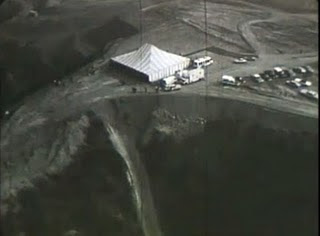
In the photo above, a huge tent is perched at the top of a carved-out hillside in preparation for a celebration marking the start of construction of Art Center College of Design in 1974.

Here are two wider views that show the massiveness of the swath that was cut along the hillsides:


Art Center College of Design was founded in 1930 in Los Angeles, and the move to Pasadena 40-plus years later was a big, big deal.

Local dignitaries, special guests with household names and lots of Art Center students and faculty gathered to celebrate what would become one of Pasadena's finest institutions of higher learning.


Don Kubly was president of Art Center at the time and is shown here with a model of the campus featuring the building designed by architect Craig Ellwood (the female student isn't identified):


Here's an excerpt from his 1971 President's Report:

“We are not just moving from one building to another; we are creating a whole new climate for a design college that can influence, not just our own college community, but also the design thinking and attitudes of all those we serve outside of our community—the businesses, the industries, and the society itself.”
Here's Kubly (center) at the event, toasting the occasion with, from left, Pasadena Mayor Mortimer J. Matthews, architect Craig Ellwood, designer Charles Eames and board member Philip S. Fogg.


Here's Mayor Matthews's photo from the Hall of Mayors:


Excerpt from a Nov. 16, 1974, Pasadena Star-News article written by Gary Clark:

It couldn't quite be called a groundbreaking since giant earthmovers long since had carved a bench into the San Rafael Hills overlooking the Rose Bowl and Arroyo Seco.

So instead, guests clustered under a large white-and-yellow-striped tent to sip champagne, to see how the $7.6 million campus will look when completed and to hear about the accomplishments from members of the Art Center family. . .

. . .The campus, located near the top of Lida Street, is scheduled for completion in 1976. The panorama of Pasadena offers itself as a view, but unlike many large-scale developments, the Art Center gives something back in its design.

The most striking feature shown in the artists' renderings and models in the low, single-building structure which will house the entire center. The building will be set back away from the rim of the lot so that the steel and bronzed glass building will be partially hidden -– harmonizing with rather than dominating the landscape.
After all these years, what we now call the hillside campus is lush with sycamore trees, pines and other flora.


Art Center has a number of photos in the historic archives pages of their website.

There's also video of the event in the tent.


Many thanks to Art Center College of Design for use of the historic photos and video.

Thursday, November 5, 2009

Mystery History -- Solved


Susan wins with her 7:30 a.m. Tuesday guess "Is it Canto Robledo, the blind Latino boxing sensation, who will be honored by the City?"

In these photos, shot in July 1978, boxing trainer and coach Canto Robledo is very animated as he gives advice (above) and shouts instructions to his fighter in the ring.


Canto Robledo was born in 1913 in Tyron, New Mexico, and moved to Pasadena with his family 10 years later.

By the time he was 19, he won the Pacific Bantamweight Championship and was ranked as a world contender.


Just two years later his boxing career was over. Detached retinas in both eyes left him completely blind after several operations proved unsuccessful.

Years of depression followed, but he was able to lift himself up eventually and in 1940 began training local Pasadena boys in the art of pugilism.

He made history in 1949 when he was the first totally blind person to receive his professional trainer's license in the sport of boxing. He established Crown City Boxing Stables that same year, serving as a mentor to young boys, and the Pasadena Police Department referred many wayward youngsters to his gym for guidance, discipline and structure. He also sponsored amateur boxing shows at John Muir High School, Pasadena High School and Pasadena City College.

Shortly before he passed away in 1999 at age 86 from complications of a stroke, the World Boxing Organization awarded him a replica of the Pacific Bantamweight Championship belt that he had won but never received for his win over Speedy Dado.

There's an interesting 1985 Los Angeles Times feature about Canto Robledo here.

Just over a week ago the Pasadena City Council approved a memorial to honor Canto Robledo at Villa-Parke Community Center.


The memorial will feature a 37- by 25-inch bronze wall relief, and and an adjoining 10- by 16-inch plaque will explain Robledo’s accomplishments and contributions in detail.


Many thanks to Los Angeles Public Library.