Showing posts with label Judge Benjamin Eaton. Show all posts

Friday, April 16, 2010

Monuments and Memorials in Pasadena


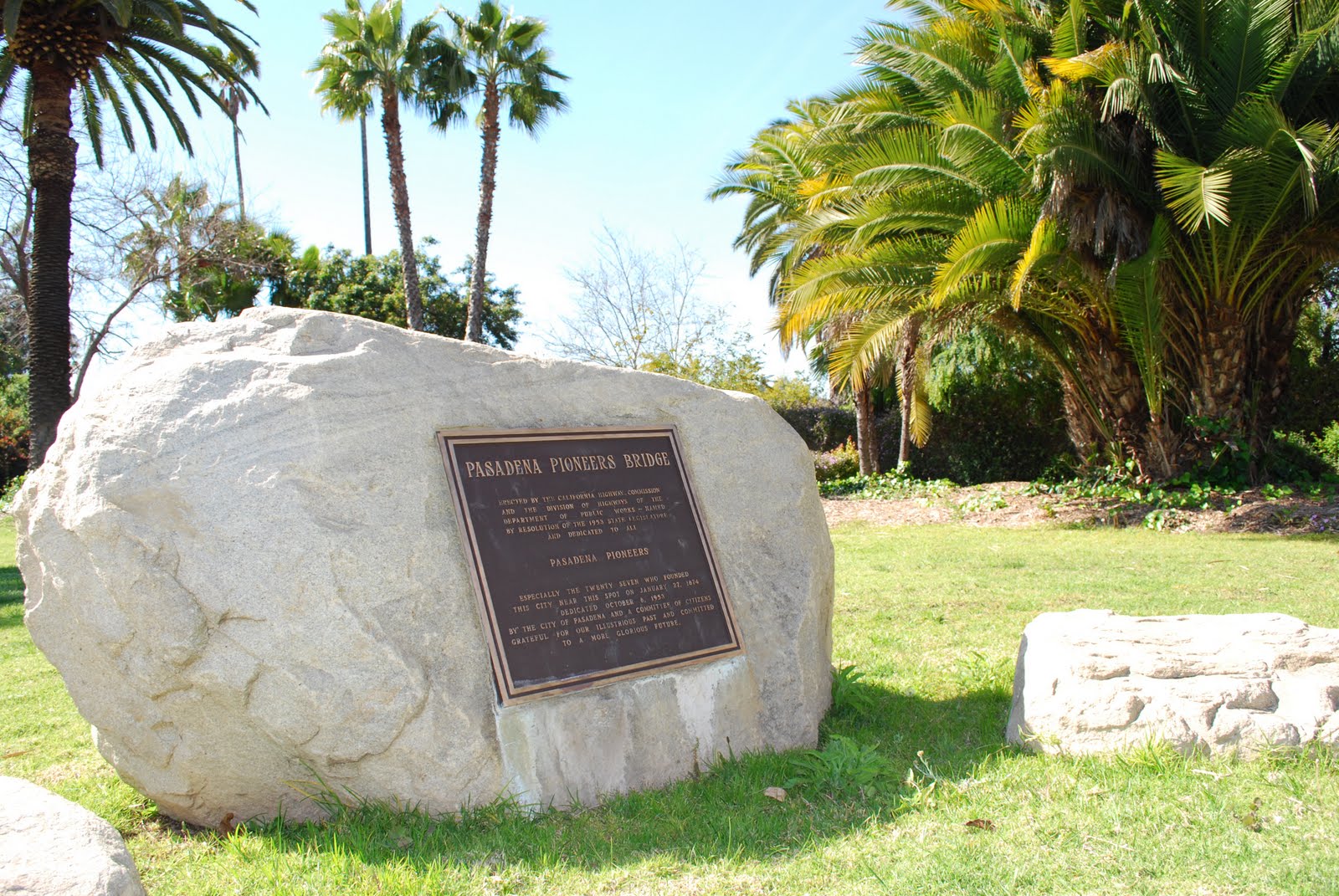
I gave the mighty Zack Stromberg -- my graphic designer in the Public Affairs Office -- the assignment of photographing monuments and memorials in public rights of way and on public property throughout Pasadena. For the past month or so he has been snapping away when time and weather permit.

The Pasadena Pioneers Bridge Rock is a native boulder with a plaque embedded on it. It's on the west side of Orange Grove Boulevard overlooking the 134 Freeway.


The inscription reads:

Pasadena Pioneer Bridge

Erected by the California Commission and the Division of Highways of the Department of Public Works – named by resolution of the 1953 state legislature and dedicated to all

Pasadena Pioneers

especially the twenty seven who founded this city near this spot on January 27, 1874. Dedicated October 8, 1953 by the City of Pasadena and a committee of citizens grateful for our illustrious past and committed to a more glorious future.


Here's one more for now:


Founders Monument was dedicated Jan. 27, 1954, and rededicated Nov. 12, 1986, when a new plaque replaced the original marker, which had been stolen (shame on you, whoever you are).

It's at Defenders Park, southwest corner of Orange Grove and Colorado. The stones were recycled from the library building that was constructed in 1890 at what is now Memorial Park.


The inscription:

This monument is dedicated in honor of the twenty-seven founders of the City of Pasadena. Near this spot on January 27, 1874 the original purchasers of land in the Rancho San Pasqual met and selected each his choice of lots.

J.H. Baker * Col. J. Banbury * W.J. Barcus * Henry G. Bennett * D.M. Berry * A.O. Bristol * W.T. Clapp * T.E. Croft * A.W. Dana * B.S. Eaton * Dr. T.B. Elliott * C. Fletcher * N.R. Gibson * P.M. Green * H.J. Holmes * A.W. Hutton * Ward Leavitt * T.E. Lippencott * L.J. Lockhart * T.J. Lockhart * J.M. Matthews * I.N. Mundell * A.O. Porter * N. Strickland * Mrs. C.A. Vawter * E.J. Vawter * E.J. Yarnell

Pasadena Pioneer Association
November 11, 1986


I'll post more of these in the weeks and months to come.

Thursday, October 15, 2009

Mystery History -- Solved


Bellis wins with her Tuesday 9:10 a.m. guess “It's an outing of early Pasadenans to Devil's Gate (before the dam). You can see the devil in the background - someone's climbed on his head!” Bellis, please email me at pasadenapio@gmail.com and I’ll tell you all about your fabulous prize.

In the undated photo above, presumably shot in the late 1890s, a group on an outing stops at Devil’s Gate.

There’s not much more than a puddle of water in the photo.

Here's the same location with much more water, probably shot in winter or spring.


And here's a 1934 shot, probably in the summertime, when it was dry as a bone:


Benjamin Eaton named the gorge Devil’s Gate because of the stone formation that looked like a devil's profile, right down to the horns.

Eaton, a visionary engineer and later a district attorney and judge, was a founding resident of the Indiana Colony who designed pipelines between 1865 and 1874 that brought water southward from Devil’s Gate and the canyon now named after him, making possible the eventual development of Pasadena.

The three-mile pipeline out of Devil's Gate brought water directly to a reservoir near the present-day Pasadena Museum of History (Walnut Street at Orange Grove Boulevard). At the south end of this reservoir, another pipeline brought water to the southern portion of the Indian Colony in what is now South Pasadena.

Here's an early photo in which you can see a section of pipeline along the lower left wall of the gorge.


With water for agricultural irrigation and domestic use, the settlers’ vision was becoming reality.

Here are selected scenes from the 15-minute film "Eaton's Water" that was produced with the intention of including water studies in local sixth-grade curriculum:


I've never seen the entire film. Does anybody out there have it?

How did the dam come to be?

After torrential floods in 1914 and 1916 that devastated the Arroyo Seco, a bond issue to fund construction of a flood-control dam was placed on the ballot in 1917 for all Los Angeles County voters. It passed.

Here are couple of photos of the 100-foot-tall dam under construction in 1920:


And here's the completed project:


I like this long shot that shows the vast upper Arroyo Seco, including where Jet Propulsion Laboratory would someday be built.


With the construction of the dam, there was no longer any public access to the devil’s profile. Many years later the formation was covered in gunite, rendering it nearly unrecognizable.


There's much more detailed history that I could go into -- the fight for water rights, improvements to the dam, more flooding, the many plans over the years for the future of Hahamongna -- but I'll let you research all that on your own time.

Fast-forwarding to the present, take a look at the current Hahamongna Watershed Park Master Plan, including Devil's Gate Dam information.


Many thanks to Pasadena Public Library, Arroyo Seco Foundation and Pasadena Museum of History.

Thursday, July 16, 2009

Mystery History -- Solved


Karin wins out of sheer tenacity: "I figure if I keep saying the same thing week after week, eventually I'll be right. People walking on colorado blvd when Pasadena was known as the Indiana Colony." Close enough, kiddo! Hey, I'm nothing if not fair.

In the photo above, a parade of Indiana Colony residents heads west down Colorado Street in September 1885 to celebrate the coming of the first railroad to these parts.

From the 1917 book “Pasadena, California, Historical and Personal, A Complete History of the Indiana Colony” by John Windell Wood:

...the whistle of the first locomotive to enter the good town echoed in every household and sounded its new note of progress. The citizens hurried with one accord down Colorado Street to view the iron horse, the first to enter, and bid it a merry welcome. Morris W. Reeder, who died in 1917 at Lamanda Park, held the throttle and enjoyed himself sounding the shrill jubilation loud and often, until the most distant and most inattentive must know that something unusual was afoot—as indeed it was.
Here’s an 1885 photo of the train making its way from Los Angeles north to Pasadena along the same route as the present-day Metro Gold Line:


But let’s back up for a moment.

In 1872 a number of families escaped the coldest winter ever experienced in Indiana and settled here.

Getting here wasn’t easy: They had to take a train to San Francisco, then a ship to San Pedro, then ride on wagons inland until they came upon this lovely little spot at the foot of the San Gabriel Mountains.

In 1874 they officially named the spot the Indiana Colony.

Two years later the Southern Pacific Railroad left bustling San Francisco and headed down brand new tracks bound for Los Angeles (population 10,000), linking the two cities for the first time.

That didn’t help the Indiana Colony. The only public transportation between here and Los Angeles was a stagecoach that was put into service three times a week. Those who could afford it could pay for private service from the John Allin Livery Company on Raymond just above Colorado Street:


More from the book:

The growing colony was quite satisfied with a stage for a time, it was safe and it was picturesque; but better and quicker service was hoped for. To Stanley P. Jewett, a young engineer, there came the idea of a railroad communication between Los Angeles and the fertile valley of the San Gabriel; tapping its settlements and growing with them—that was the expectation. Jewett lived in the Indiana Colony, where he had come in 1879, and had pondered much over this idea.
Jewett tried to get L.A. bankers to invest in his plan – including James Filmore Crank* who lived on a ranch in these parts called Fair Oaks – but the deal fell apart and the bankers walked away. Except one.

J.F. Crank had a change of heart and brought together other Indiana Colony investors including his brother-in-law, Albert Brigden, who also had a ranch, and this group of local investors raised $450,000 for the ambitious effort.

There were fits and starts throughout the project, from rights of way being only partially secured to contractors going belly up. So Jewett took charge of the entire endeavor.

A public meeting was called by the exercised people, who passed very urgent resolutions voicing the loudly expressed sentiment declaring “the importance of bringing the locomotives to our very doors, etc,,” all of which is somewhat different than some of the expressions now heard, which declare that this road is a menace upon our streets and must be removed!
A committee made up of Indiana Colony leaders who have streets named after them today – including J.P. Woodbury and James Craig – worked with Jewett to maneuver through legal mazes and other complicated matters.

Fast-forward to that long awaited day when the locomotive chugged into town to the waiting throngs! Here are people enjoying some rest and refreshments in what was probably very welcome shade:


Beginning that celebratory day, the train ran on a regular schedule between L.A. and the Indiana Colony.

Tourists, new residents and entrepreneurs began flocking to the area via the LA&SGV Railroad. The next year, in 1886, the town known as the Indiana Colony was incorporated and renamed Pasadena.

And the rest is no mystery!

* J.F. Crank was a nationally famous figure in his day. After purchasing Fair Oaks Ranch from Judge Benjamin Eaton, Crank hired workers to till the soil, then planted the first varietal citrus seeds in the Indiana Colony. The seeds germinated and grew into trees, and he made a fortune off this area's first orange groves. After bringing together the local investors for the railroad line to Pasadena, Crank became president of the Los Angeles & San Gabriel Valley Railroad, the tracks of which went all the way to Duarte before he sold the rights of way to the Santa Fe Railroad for a whole heck of a lot of money. He was also among the investors who created Monrovia.

Many thanks to Pasadena Public Library and Pasadena Museum of History.