Showing posts with label Rose Bowl Stadium. Show all posts

Thursday, June 16, 2011

Mystery History -- Solved!


Ben, our resident baseball guru, got it right off the bat (get it?) with his 6:30 a.m. Tuesday guess "Walter O'Malley checking out the Rose Bowl as an option to house the Brooklyn Dodgers."

In the 1957 photo above, National League President Warren Giles, Brooklyn Dodgers owner Walter O'Malley and Pasadena City Manager Don McMillan stand on the field of the Rose Bowl Stadium during contract negotiations that would enable the Dodgers to play at the stadium for up to two seasons during their transition to Los Angeles.

O'Malley, a real estate mogul, decided to move the Dodgers out of Brooklyn because the decrepit Ebbets Field was no longer a viable option for league play and his proposal for building a modern stadium in that burrough fell through when he could not get support for suitable land.

In May 1957 the National League approved the move to Los Angeles, and in October 1957 the L.A. City Council made it official.

But where would the newly named Los Angeles Dodgers play their 1958 season? And how about 1959?

O'Malley's grand plans for a stadium at Chavez Ravine couldn't take shape in time for a number of reasons that I won't go into here (look it up), so he and L.A. city officials turned to Pasadena to discuss a possible temporary home at the Rose Bowl Stadium.

Here from left to right, Los Angeles Mayor Norris Poulson, Pasadena Mayor Seth Miller and O'Malley pore over a map of the Rose Bowl Stadium on Dec. 11, 1957:


During the Dec. 17, 1957, meeting of the Pasadena Board of City Directors (now called the City Council), the chamber was packed with people, many in favor and many opposed to the Dodgers using the stadium.

Excerpt from the minutes of that meeting:
The Chairman announced that the matter of use of the Rose Bowl by the Brooklyn Dodgers would now be taken up and on the order of the Chairman, the City Clerk announced that to this hour, 150 letters were received expressing opposition to the use of the Rose Bowl by the Dodgers, which includes 5 organizations, and that 40 letters were received favoring the said use by the Dodgers which includes 9 organizations.

There was plenty of testimony in the chamber during the meeting.

Here's Oliver B. Prickett representing the Linda Vista Association in opposition of the proposal:
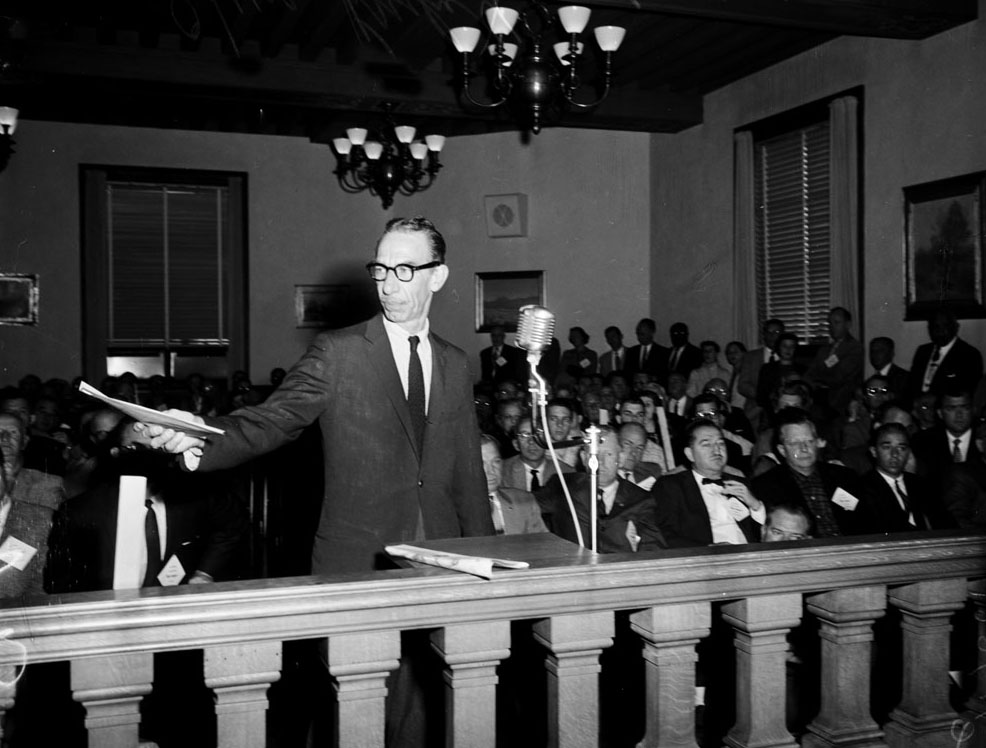

Richard Spaulding representing sporting groups in favor of it:


And James B. Wilcott speaking in favor on behalf of the Pasadena Quarterbacks:


Dozens of people gave their public testimony, for and against. After all was said and done:
Moved by Director Benedict,
"That we direct the City Manager to work out the details of a contract with Walter O'Malley for his Dodgers Baseball Club to use the Rose Bowl as a temporary location for a period of one and one-half to two seasons".

The motion passed six to one.

Excerpts from a Los Angeles Times article Jan. 6, 1958:
Walter O'Malley will climb aboard the Dodger merry-go-round again today, hopeful that he can grab the brass ring -- temporary tenancy for his big leaguers in the Rose Bowl.

This morning the Dodger prexy will resume his discussions with City Manager Don C. McMillan of Pasadena, which were broken off temporarily last month when O'Malley flew east to bring his family back to California.

Their initial negotiations merely were exploratory, but with time running out -- the Dodgers' first home game will be April 18 against the San Francisco Giants -- O'Malley realizes that he must get down to brass tacks.

There is some organized opposition to the Dodgers in Pasadena, principally from residents in the vicinity of the bowl. However, the bulk of the Crown City's citizenry, including leading merchants, labor groups, service and fraternal organizations, are enthusiastic about the prospect of hosting O'Malley's homeless waifs.

Joining O'Malley in his negotiations with McMillan and Rose Bowl Manager Bob McCurdy will be his legal eagle, Harry Walsh; Amos Buckly of the Allied Maintenance Co., Dick Walsh, assistant director of the Dodger farm system, and an engineer.

Business Manager Harold Parrott will be back at his Wrigley Field office today after a brief trip, and Vice President Buzzie Bavasi is expected to return from the East shortly.

Here are Don McMillan (left), Bob McCurdy, Warren Giles and Walter O'Malley going over tentative plans on Jan. 6, 1958:


But here's the thing: Just because a motion passes and negotiations begin, that doesn't mean a contract will actually be executed.

Los Angeles Times - Jan. 14, 1958:
After weeks of careful study the Dodgers' engineers reported that it would cost a minimum of $750,000 to transform the 100,000-seat Rose Bowl into a ball park of major league standards.

A joint statement issued by McMillan and O'Malley asserted that "this amount of money could not be amortized in a short-term, two-year lease." Furthermore, they agreed that "the alterations would leave physical scars on the beautiful Rose Bowl."

During the Pasadena discussions the Coliseum Commission declined to deal further with O'Malley, but some members said they would be willing to revive negotiations if the Rose Bowl plan failed.

The Dodgers would play four seasons in the Coliseum until Dodger Stadium opened on April 10, 1962.


Many thanks to Pasadena Public Library, the City Clerk's Office and USC.

Thursday, February 10, 2011

Stadium Expansion is Off and Running


I'm frightfully late in posting these photos from the groundbreaking at the Rose Bowl Stadium on Jan. 25. I served on the planning committee for the event, which marked the beginning of an extensive three-year, $152 million renovation and expansion project.

In the top photo, that's Mayor Bill Bogaard (center) on the 50 yard line, flanked by (left to right) RBOC President Victor Gordo, Tournament of Roses President Rick Jackson, UCLA Athletics Director Dan Guerrero and Legacy Campaign Director Andrea Van de Kamp.

Here's a closer look:


Later several other officials joined them on the field, including Pasadena City Council and RBOC members, and City Manager Michael Beck (second from left):


Darryl Dunn, general manager of the stadium, was the MC for the formal program, which preceded the photos above and featured several speakers:


As you can see from that shot, some preliminary stages of renovation had begun by the time this event took place, such as removal of seats.

The program was followed by a lovely luncheon on the field for about 150 people, which was capped off by a cake with very subtle symbolic decoration:


Emina Darakjy, one of the Rose Bowl neighbors, carried a rose-themed purse for the occasion. She happened to set it down next to one of the centerpieces. I couldn't resist the shot:


Perhaps the hardest worker of the day was Walt Mancini, Pasadena Star-News photographer extraordinaire whom I've worked with for 20 years:


I took all of the photos except the top one, which was shot by a photographer hired for the event. I don't do ladders.

Thursday, October 7, 2010

Mystery History -- Solved!


Nobody was absolutely spot on, but Paul Little was the first to come close with his 5:42 p.m. Tuesday comment "I'm guessing it's limos parked near the Rose Bowl during an event waiting for the game or show to be over."

In the photo above, dozens of empty limousines are parked at Brookside Golf Course during the Super Bowl game at the Rose Bowl Stadium on Jan. 26, 1987.


The New York Giants beat the Denver Broncos 39-20.


Five Super Bowls have been played at our stadium, more than any other stadium in the nation.

Now the stadium is the subject of public meetings where the financing plan for renovation and expansion is being discussed.


The Rose Bowl Operating Company will vote on the financing plan tonight at 6:30 in the Mediterranean Room at Brookside Clubhouse, and the plan is slated to go
to the Pasadena City Council for final approval this coming Monday at City Hall. That meeting will also begin at 6:30 p.m.

They're public meetings, and you're welcome to attend and weigh in during public comment.

The agenda for Monday's council meeting will be posted by about 6 p.m. tonight here.

The council meeting will be televised live on KPAS (cable channel 3 in Pasadena) and via streaming video here (click on the KPAS icon).

The Rose Bowl Stadium is an important historic landmark and economic resource. Is it worth saving? In this PIO's not-so-humble opinion, the answer is yes.


Many thanks to the Rose Bowl Stadium and the National Football League.

Thursday, September 16, 2010

Mystery History -- Solved!


I liked the variety of guesses for this one, from "miners digging out the last of our coal and/or gold reserves" to "it has something to do with a dam being built at the bottom of Hahamongna."

Frank Girardot wins with his 3:56 p.m. Tuesday guess "building of the rose bowl in arroyo seco."

I tried to throw everybody off the scent by cropping in on this photo:


Architect Myron Hunt designed the Rose Bowl Stadium, which for several years was a horseshoe shape that was open on the south side. Here's Hunt, right, looking over an early model with builder William A. Taylor:


And here's an aerial shot of the nearly completed stadium:


But the project really began with laborers and mules. Imagine the back-breaking work of digging out all that dirt along with all those rocks and boulders.


In 1920, to fund the stadium's $272,000 construction, Myron Hunt, Tournament of Roses President William Leishman and several others devised a plan to sell subscription tickets for stadium events for the next 10 years at a cost of $10 per person per year -- $100 total -- all up front. It worked.

Construction took less than a year; the stadium was ready in time for the 1923 football game with USC vs. Penn State (USC won, 14 to 3).


And now the stadium is poised for a $171 million renovation and expansion. Design plans are going through the commission process and the financial plan will be coming to the Pasadena City Council soon.

It's a far cry from the $272,000 raised to build the stadium 90 years ago but it sure will be worth it!

I'll leave you with this aerial shot of the stadium during the BCS final game on Jan. 7 this year (Alabama 37, Texas 21):


Many thanks to the Pasadena Museum of History, Rose Bowl Stadium and Tournament of Roses Association.

Saturday, April 3, 2010

First-ever Pasadena Collegiate Field Tournament


Today at the first-ever Pasadena Collegiate Field Tournament at the Rose Bowl Stadium, we proved that we're a college town extraordinaire when teams from Art Center College of Design, Caltech, Fuller Theological Seminary, Le Cordon Bleu College of Culinary Arts, Pacific Oaks College and Pasadena City College competed for the top prize in a series of goofball challenges.

In the photo above, PCC President Lisa Sugimoto presents a platter of burgers to the judges during the Cheeseburger Challenge.

During this challenge, teams of two from each college had to assemble a grill and prepare cheeseburgers to wow the palates of judges (seated left to right below) restaurateur Jack Huang, City Councilwoman Jacque Robinson and Honda Design Center Director Dave Marek.


Here's the Art Center team creatively assembling their grill.


And a member of the Fuller team faithfully biding her time while the meat marinades, a technique they prayed would get them high marks.


The judges may have needed some Alka Seltzer by the time this competition was over!


The team from Le Cordon Bleu won the challenge.

A fun little irony was that the food cooked in the Cheeseburger Challenge was for the judges; when noon rolled around and people got hungry, Robin's was there with cheeseburgers, hot dogs and lemonade to the save the day. (That's Fuller PR Director Fred Messick waving.)


But wait -- I'm getting ahead of myself.

It all started with the National Anthem sung by a chorus made up of one member of each college team plus a referee.


John Rabe of KPCC Radio's "Off-Ramp" served as master of ceremonies.


During each challenge, teams racked up points, with some shaved off if necessary for penalties, and the team with the highest score at the end of the tournament won the grand prize.

In the Monster Croquet challenge, teams had to use a monster-size mallet to push a monster-size ball through monster-size wickets. Here's the Cordon Bleu team:


The Art Center team (with a Cordon Bleu interloper):


Then it was the Frisbee Toss. Teams had to catch Frisbees tossed from downfield in the time allotted. Here's PCC:


And Le Cordon Bleu:


For the meteor toss, each team was provided with a bag in which there were pieces of fabric and some duct tape. They had to create what they thought would be the perfect catching implement for a series of "meteors" that were lobbed at them. This may have been the most important challenge of all because each team was charged with saving the world from certain destruction!

The Pacific Oaks team had their strategy for assembly...


...and Art Center had theirs:


All of the teams were fearless against the hurtling meteors -- from tennis balls to potatoes -- hurled via slingshot by Eric Duyshart, the city's economic development manager:


Here's Caltech saving planet earth:


In the Blind Faith Challenge, each team had one blindfolded member who had to take a series of pennants from the field, guided only by the voices of teammates. Here's the PCC team:


Next it was the Giant Puzzle Race. In this competition, teams had to run to the far side of the field to get individual puzzle pieces color-coded for their specific colleges, then run back and assemble them.


Once the puzzles were assembled, they revealed a map of sorts showing the various college locations and then some.


The Art Center team couldn't help themselves -- after this competition was over they created a sculpture with the puzzle pieces!


Before I forget, each team had a station complete with a bench and a round throw. Here's the Pacific Oaks station, which they appropriately adorned with children's pinwheels:


And here's Jered Gold, Art Center's director of public relations and communications, on the college's iconic orange dot:


While I make you wait in suspense about which college took the grand prize, here's Tony Bondi, president of Le Cordon Bleu:


The teams also earned points for their uniforms. Art Center's uniforms were an homage to the college's founder, Edward "Tink" Adams.

And Caltech students donned Albert Einstein wigs, although they took them off during physical competitions.


Many people from the community stopped by to watch the action, including Phoebe and Larry Wilson:


And now, without further ado, the college with the highest number of points overall: Caltech!


Mayor Bill Bogaard presented the trophy to the team leader...


...then all of the teammates shared in the thrill of victory.

By the time everyone was leaving the stadium, the trophy was entrusted to Caltech President Jean-Lou Chameau for safe-keeping.


Final team scores (along with their team colors), provided by Eric Duyshart:

Caltech 194
PCC 162
Fuller 160
Le Cordon Bleu 145
Art Center 143
Pacific Oaks 139

The entire event was shown live on the stadium's big screens. I'm told it was also recorded, so whenever I get a DVD I'll do some editing and run it on KPAS.


Gigantic kudos to Eric Duyshart, Ariel Penn and others in the Planning and Development Department who made this event happen, and thanks so much to all the colleges for participating!