Thursday, June 16, 2011

Mystery History -- Solved!


Ben, our resident baseball guru, got it right off the bat (get it?) with his 6:30 a.m. Tuesday guess "Walter O'Malley checking out the Rose Bowl as an option to house the Brooklyn Dodgers."

In the 1957 photo above, National League President Warren Giles, Brooklyn Dodgers owner Walter O'Malley and Pasadena City Manager Don McMillan stand on the field of the Rose Bowl Stadium during contract negotiations that would enable the Dodgers to play at the stadium for up to two seasons during their transition to Los Angeles.

O'Malley, a real estate mogul, decided to move the Dodgers out of Brooklyn because the decrepit Ebbets Field was no longer a viable option for league play and his proposal for building a modern stadium in that burrough fell through when he could not get support for suitable land.

In May 1957 the National League approved the move to Los Angeles, and in October 1957 the L.A. City Council made it official.

But where would the newly named Los Angeles Dodgers play their 1958 season? And how about 1959?

O'Malley's grand plans for a stadium at Chavez Ravine couldn't take shape in time for a number of reasons that I won't go into here (look it up), so he and L.A. city officials turned to Pasadena to discuss a possible temporary home at the Rose Bowl Stadium.

Here from left to right, Los Angeles Mayor Norris Poulson, Pasadena Mayor Seth Miller and O'Malley pore over a map of the Rose Bowl Stadium on Dec. 11, 1957:


During the Dec. 17, 1957, meeting of the Pasadena Board of City Directors (now called the City Council), the chamber was packed with people, many in favor and many opposed to the Dodgers using the stadium.

Excerpt from the minutes of that meeting:
The Chairman announced that the matter of use of the Rose Bowl by the Brooklyn Dodgers would now be taken up and on the order of the Chairman, the City Clerk announced that to this hour, 150 letters were received expressing opposition to the use of the Rose Bowl by the Dodgers, which includes 5 organizations, and that 40 letters were received favoring the said use by the Dodgers which includes 9 organizations.

There was plenty of testimony in the chamber during the meeting.

Here's Oliver B. Prickett representing the Linda Vista Association in opposition of the proposal:
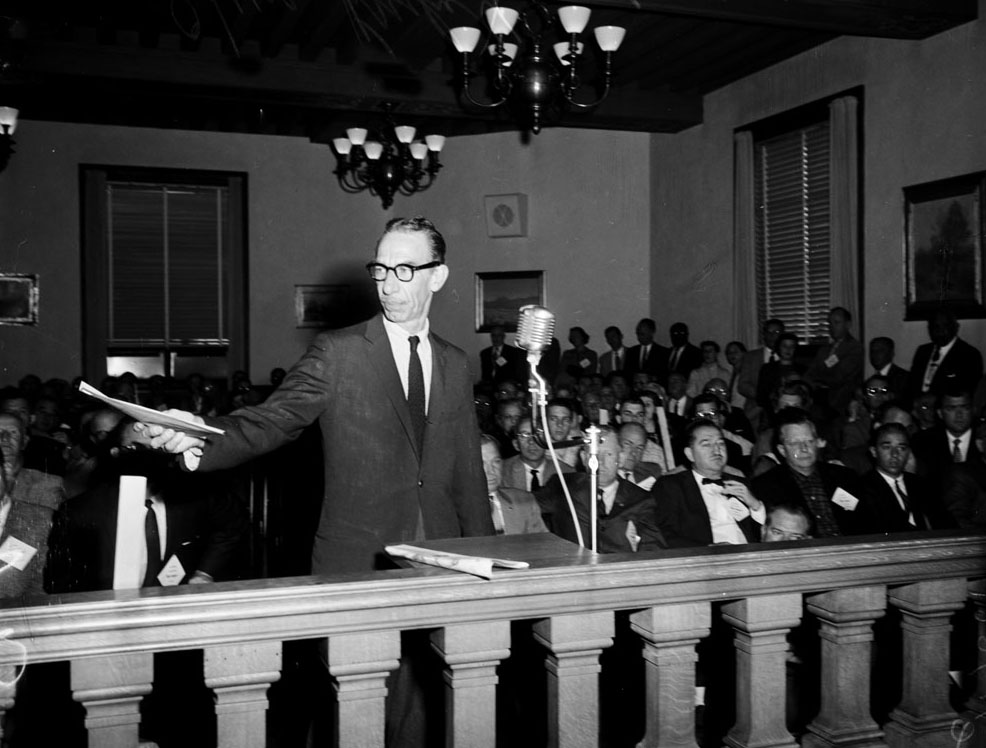

Richard Spaulding representing sporting groups in favor of it:


And James B. Wilcott speaking in favor on behalf of the Pasadena Quarterbacks:


Dozens of people gave their public testimony, for and against. After all was said and done:
Moved by Director Benedict,
"That we direct the City Manager to work out the details of a contract with Walter O'Malley for his Dodgers Baseball Club to use the Rose Bowl as a temporary location for a period of one and one-half to two seasons".

The motion passed six to one.

Excerpts from a Los Angeles Times article Jan. 6, 1958:
Walter O'Malley will climb aboard the Dodger merry-go-round again today, hopeful that he can grab the brass ring -- temporary tenancy for his big leaguers in the Rose Bowl.

This morning the Dodger prexy will resume his discussions with City Manager Don C. McMillan of Pasadena, which were broken off temporarily last month when O'Malley flew east to bring his family back to California.

Their initial negotiations merely were exploratory, but with time running out -- the Dodgers' first home game will be April 18 against the San Francisco Giants -- O'Malley realizes that he must get down to brass tacks.

There is some organized opposition to the Dodgers in Pasadena, principally from residents in the vicinity of the bowl. However, the bulk of the Crown City's citizenry, including leading merchants, labor groups, service and fraternal organizations, are enthusiastic about the prospect of hosting O'Malley's homeless waifs.

Joining O'Malley in his negotiations with McMillan and Rose Bowl Manager Bob McCurdy will be his legal eagle, Harry Walsh; Amos Buckly of the Allied Maintenance Co., Dick Walsh, assistant director of the Dodger farm system, and an engineer.

Business Manager Harold Parrott will be back at his Wrigley Field office today after a brief trip, and Vice President Buzzie Bavasi is expected to return from the East shortly.

Here are Don McMillan (left), Bob McCurdy, Warren Giles and Walter O'Malley going over tentative plans on Jan. 6, 1958:


But here's the thing: Just because a motion passes and negotiations begin, that doesn't mean a contract will actually be executed.

Los Angeles Times - Jan. 14, 1958:
After weeks of careful study the Dodgers' engineers reported that it would cost a minimum of $750,000 to transform the 100,000-seat Rose Bowl into a ball park of major league standards.

A joint statement issued by McMillan and O'Malley asserted that "this amount of money could not be amortized in a short-term, two-year lease." Furthermore, they agreed that "the alterations would leave physical scars on the beautiful Rose Bowl."

During the Pasadena discussions the Coliseum Commission declined to deal further with O'Malley, but some members said they would be willing to revive negotiations if the Rose Bowl plan failed.

The Dodgers would play four seasons in the Coliseum until Dodger Stadium opened on April 10, 1962.


Many thanks to Pasadena Public Library, the City Clerk's Office and USC.

Tuesday, June 14, 2011

Mystery History


Where are we? And what's happening?

The first person to guess correctly will win a fabulous prize!

I'll have the full scoop on Thursday.

Monday, June 13, 2011

Our 125th Birthday Kickoff


Thousands gathered throughout the day on Saturday for the kickoff to Pasadena's 125th birthday celebrations. The opening bash was at the Pasadena Museum of History, where the galleries and grounds were bustling with excitement.

People waited eagerly for events to begin on stage:


Mayor Bill Bogaard was a big part of the festivities:


Children's activities included storytellers who engaged audiences throughout the day...


...and fancy hat-making, such as this chapeau created and worn by Anastasia Rodriguez:


And then it was time for the enormous and elaborate birthday cake created by pastry chefs at Le Cordon Bleu College of Culinary Arts in Pasadena:


But wait -- there's more! Click here for information about additional 125th birthday celebrations in the near future.


Many thanks to Linda Centell, Petrea Burchard and Terry Miller.

Tuesday, June 7, 2011

Mystery History -- Solved!


I stumped everybody this week, although plenty of people provided clever guesses.

In the photo above, shot on Oct. 25, 1951, Pasadena City Manager Don C. McMillin accepts $2 from 7-year-old Bobby Bukshpan for a previously owned bicycle at the Pasadena Civic Auditorium during what was billed as the world's largest rummage sale. McMillin served as a volunteer cashier at the event, which was a benefit for the California Junior Republic Auxiliary.

I'll let these other photos speak for themselves:


Nowadays rummage sales aren't so popular. But plenty of people in Pasadena have yard sales on their properties. Remember, you need a permit! You can get two yard sale permits annually, each of which is good for up to three consecutive days.


Many thanks to USC.

Mystery History


Where are we? And what's happening?

The first person to guess correctly will win a fabulous prize!

I'll have the full scoop on Thursday.

Friday, June 3, 2011

Looking for Something to Do?

Saturday, June 4, from 8:30 a.m. to 4 p.m. – Get Healthy Pasadena is a day of free health screenings, healthy food and lifestyle demonstrations and activities, talks by leading health professionals, live music and much more at Pasadena Senior Center and Memorial Park. Pre-register here or call (626) 389-2758.


Saturday, June 4, from 10 to 11 a.m. – A new tree has been planted at the top of the Victory Park’s “V” garden at the northeast corner of Altadena Drive and Paloma Street in recognition of former Pasadena City Councilman Steve Haderlein’s 12 years of service to District 4. Stop by and see the tree, greet Steve and enjoy this very special section of the park.


Saturday, June 4, from 11 a.m. to 2 p.m. – Bring your family and friends to an open house at the Pasadena Police Department Heliport! See the helicopters up close, meet the pilots, see K-9s in action, watch CSI demonstrations, enjoy refreshments and much more.


Monday, June 6 -- Is your child or teen the artsy type? Today’s the deadline for entries in PWP’s water conservation poster art contest.


Tuesday, June 7, at 6 p.m. – Wondering why all that road construction is being done on North Los Robles and when it will be completed? Learn all about it during a community meeting hosted by Pasadena City Councilwoman Jacque Robinson.


Tuesday, June 7, at 6:30 p.m. – This is your final opportunity to meet with City Manager Michael Beck and give him your input on the ideal qualities the next director of public works should possess and the issues the director should be prepared to undertake.


Wednesday, June 8, at 1 p.m. – This week’s film in the Donald R. Wright Auditorium at Pasadena Central Library is “Charly” (1968, PG) adapted from the novel “Flowers for Algernon” by Daniel Keyes. The film stars Cliff Robertson, who won the Academy Award for his role as a developmentally challenged man who gradually develops a genius-level IQ following experimental surgery and then learns it won’t last long.


Wednesday, June 8, from 4:30 to 6 p.m. – The community is invited to a reception welcoming Mercy Santoro, the new director of the Human Services and Recreation Department.


Saturday, June 11, from noon to 7 p.m. – It’s Pasadena’s 125th birthday party extravaganza at the Pasadena Museum of History, complete with a cake created by chefs from Le Cordon Bleu College of Culinary Arts, live music, dance, theater, storytelling, exhibitions, children’s activities and much more! Admission, activities and birthday cake are free; food prepared by local restaurants will be offered for sale. Birthday events are also scheduled throughout the summer at City Hall, the Rose Bowl Stadium, Memorial Park and other locations.

Admission is free to all of these events. See a more comprehensive schedule of events sponsored by the City of Pasadena for the same time period, including city council and commission meetings, here.

See more community events (and add your own) at www.cityofpasadena.net/calendar.


Many thanks to Kevin Joyce for the photo from the 2010 heliport open house and Pasadena Museum of History for the 125th birthday photo.

Thursday, June 2, 2011

Mystery History -- Solved!


A few people nibbled around the edges but two people came closest first, so I'm calling it a tie: Karin with her 7:48 a.m. Tuesday guess "I think they're filming a movie in Castle Green" and Daniel with his 4:10 p.m. Tuesday guess "It is Rudy Valentino kissing the hand of a woman in the Hotel Green, now known as the Castle Green."

In the 1919 photo above, silent screen star Rudolph Valentino kisses the hand of Dorothy Gish at the Hotel Green during a scene from "Nobody Home." The film, also called "Out of Luck," is about an extremely superstitious young woman who is wooed by two men: one villainous and one virtuous. Valentino played the shady guy. (The plot thickens!). There's a nice little story about the filming here.

Now the historic Castle Green, the building was once part of a trio of hotel buildings in the vast Hotel Green complex.

Here's a circa 1905 photo that shows all three buildings in the complex. If you look very closely, you can see the enclosed bridge that connected the buildings on the west and east side of Raymond (half the bridge, including the little tower, still stands today). The photographer was standing in the new Central Park.


And here's a page from a historic illustrated souvenir booklet showing the huge complex from a similar angle, with the park a little more mature.


The one-story building at the southeast corner of Raymond Avenue and Green Street -- now Stats Floral Supply -- is all that's left of the east building in the complex. Note the curvature of the window on the corner, which is very similar to the two remaining buildings.


Here's the Castle Green today on the west side of Raymond Avenue between Green and Dayton streets:


The interiors are spectacular and haven't changed much in all these years:


And here's the original portion of the complex, which now is the Green Hotel Apartments at the southeast corner of Green Street and Fair Oaks Avenue, along with some first-floor businesses:


I've seen and heard the history dozens upon dozens of times. Perhaps the best eye-witness account is in my favorite local reference book, "Pasadena: Historical and Personal" by J.W. Wood, published in 1917, which can be found in the Centennial Room at Pasadena Central Library:
The Green was an outcome of the frenzied boom and Ed Webster's altitudinous ambition. Webster was the top-notcher in enterprise about 1886-87, when ranches were being sliced up into town lots. Property owners like Romayne Williams and P.G. Wooster, who fortunately owned "ranches" down along the newly opened Raymond Avenue, were strictly "in it." Wooster owned the property where now stands the Green Hotel and part of Central Park. Williams' land lay just south of Wooster's; therefore, when came the trend of speculation in that direction, Wooster parted with some of his land to Webster and Webster started to build a hotel on it. To help things along, he also built a depot for the Santa Fé on condition that that road would move its office from north of Colorado Street, where it then was, to the new location. Of course, this being handed a fine new brick depot that cost $10,000, situated on a fine lot, all free of charge, the Santa Fé people couldn't refuse, and with due modesty and kindly feeling moved to the new location. This was in 1887. Thus was begun the original edifice, then called the Webster, later the Green Hotel.

Colonel Green happened into Pasadena one fine day and met Andrew McNally and some other congenial spirits. I believe William Morgan later joined "the crows." It didn't take Webster long to get these gentlemen interested in Pasadena, and it was through his efforts that they eventually made large investments and became regular winter residents. Then Webster ran out of money, and what more natural than that he borrow from Green? He did that very thing, and in the distressful end, when Webster got a monkey wrench in his financial machinery, Green had a two-story unfinished hotel on his hands that he did not want. This was in 1891. Morgan fared likewise, but only drew a smaller building on Raymond Avenue which still is part of the Morgan estate.

Green enlarged and improved his purchase and made it a high-class hostelry. He built the west wing in the park that surrounds it; then buying the Wooster Block on Fair Oaks Avenue, and including that in the plant in 1895. J.H. Holmes, a brother-in-law of Colonel Green, was made manager of the business and brought to it much fame as a high-class hotel; for Major Holmes had the "hotel genius," lacking which it bodes no man to attempt such an undertaking. These two structures, the east and the west wing, are joined, Siamese twinlike, by a bridge which spans the thoroughfare between – an unique link. Not a "bridge of sighs," indeed, but a causeway to neighborly comity between the dwelling places. The Green was conducted by Major Holmes until he became lessee of the U.S. Grant Hotel at San Diego. In 1916 the Green was leased to D.M. Linnard, who now conducts it as one of his trio, and has recreated its former prestige.
I could go on forever but I won't. You can find more history on the Castle Green and Pasadena Heritage websites.

The Castle Green is listed in the National Register of Historic Places. A homeowners association takes care of the inside of the building; Pasadena Heritage and Friends of the Castle Green raises funds for exterior restoration. (In the interest of full disclosure, I serve on the Friends board).

The Castle Green is open to the public only two days each year for tours, the proceeds of which help fund those exterior renovations. The next tour is on Sunday, June 26. The grounds behind those heavy gates, the first floor common areas and several of the privately owned apartments will be open for anyone and everyone to see and learn more about this architectural wonder designated by the city council years ago as an official City of Pasadena Treasure.

Do you have a historic property that you'd like to preserve? Take a gander at the web pages for the Design and Historic Preservation Section of the Pasadena Planning Department.


Many thanks to the Castle Green, Pasadena Public Library, Pasadena Heritage and Pasadena Museum of History.