Showing posts with label 1880s. Show all posts

Thursday, March 15, 2012

Mystery History -- Solved!

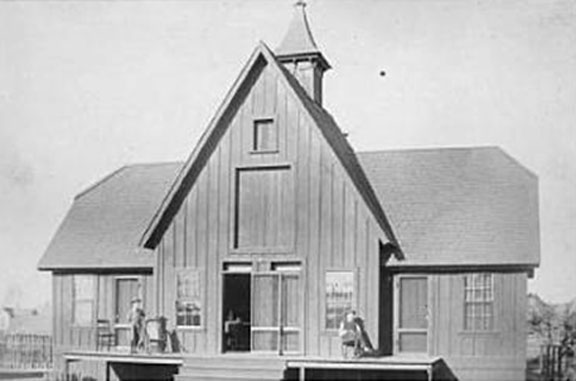
Cafe Pasadena with his 11:30 p.m. Wednesday guess "Well, it looks like early Pasadena in the late 1800s...Could easily be a tent or a barn since not much was built yet."

In the circa 1887 photo above, two adult males hang out on the back side of a barn that was used temporarily as living quarters.

During the building boom of 1886 to 1888, settlers were teeming to put down roots in the newly incorporated city. Many put up barns first -- some quite fancy architecturally -- and lived in them until homes could be built.

Pasadena looked like this in 1883 (looking north from Raymond Hill)...

...and like this seven years later (shot from the rooftop of the Hotel Green:

Here's an excerpt from my favorite local reference book, "Pasadena: Historical and Personal" by J.W. Wood, published in 1917, which can be found in the Centennial Room at Pasadena Central Library:


It was a strange overturning that began in 1886 and drove hitherto placid-minded, contented citizens to acts of frenzy and drew to the village of Pasadena thousands of boomers and speculators, turning the ordinary conditions topsy-turvy and firing the imagination of the most phlegmatic*...

...There had been occasional movements in real estate prior to the end of 1865. Now and then some one would drop into the village of Pasadena and buy ten or twenty acres of land and pay from $100 to $300 per acre, according as to whether improved and how. In 1886 there was a sudden stimulus; why, no one can exactly say. In 1887 Southern California, especially Los Angeles and Pasadena, was on the high plane of boom prices, and in 1888 -- the beginning of that year -- it had reached the climax: the blue, blue sky! Then it was
facilis decensus, indeed! leaving numerous putative "millionaires" stranded, financial wrecks -- dazed and amazed at the sudden and tragic conclusion of their dreams. This quick finish to their rose-hued visions was sickening and remorseless. 

* Tuberculosis was a big issue back then. See a related blog post here.


Many thanks to Pasadena Museum of History and Pasadena Public Library.

Thursday, April 21, 2011

Mystery History -- Solved!


Wanda wins with her 7:24 p.m. Tuesday guess "guests are enjoying their stay at the Arroyo Vista Guest House, which later became the Vista del Arroyo Hotel (quite a renovation) and is now the 9th Circuit Court of Appeals."

In the circa 1890 photo above, guests congregate outside the Arroyo Vista Guest House.

This photo is circa 1888:


Mrs. Emma C. Bangs purchased the plot of land -- several acres -- between Orange Grove and the Arroyo Seco in 1882.

The Arroyo Vista Guest House was a boarding house and hotel that served winter tourists, travelers and several people with lung disorders who had come west for a climate more tolerable for their conditions.

Here's a really fun excerpt from my favorite local reference book, "Pasadena: Historical and Personal" by J.W. Wood, published in 1917, which can be found in the Centennial Room at Pasadena Central Library:

There are many ways that might be sought to amuse. Even the sick can find opportunities. Mrs. Jennie Banbury Ford furnishes the following as illustration.

"When Mrs. Bangs' boarding house was most flourishing, there were many consumptives coming and going. It became so depressing it was suggested that they band themselves together under the head of "the busted lung brigade," and create more hopeful and cheerful feeling. The suggestion was carried out and proved very successful. They elected officers, had a beautiful silk banner with "B.L.B." embroidered on it and met all "busted lungers" with open arms. Those whose stay was ended were started on their several ways with smiles and cheers. Each member was compelled to sign the by-laws, which were amusing at least. They must not sit in a draft, must consume just so much milk and so many eggs each day and look after each other's comfort, etc. To help the fun along, Mrs. Bangs bought a parrot in Los Angeles who knew how to cough exactly like a "lunger" and contributed much to the amusement. I don't believe a more grotesque club ever existed, do you? It lasted for several years."

The guest house was eventually demolished and then rebuilt in 1920 as the magnificent, 400-room Vista del Arroyo Hotel designed by architects Sylvanus Marston & Garrett Van Pelt. A year later, architect Myron Hunt added his touches, which transformed it into the resort hotel that became so famous for so many years.


In this undated photo guests are in front of the east wing of the hotel with a trellis over the main entrance:


In this 1940s photo a fashion show is taking place on the lower portion of the property:


Here's another view of the lower grounds:


Its life as a hotel ended in 1943 when it was procured by the federal government under the War Powers Act to serve as a U.S. Army hospital. From 1951 to 1974 the building housed a number of federal agencies. It was remodeled again, and since 1981 has served as the Ninth Circuit U.S. Federal Court of Appeals.

The interior is just as spectacular as the exterior:


Here's one of the courtrooms:


There's a nice little history on the federal General Services Administration site.

Tours are offered by appointment: (626) 229-7250

I've been there a few times, mostly for staff and board retreats in one of their community rooms.

I've always loved this photo, which is courtesy of the Pasadena Convention and Visitors Bureau:


Many thanks to the Pasadena Museum of History, University of Southern California and Richard H. Chambers U.S. Court of Appeals.

Thursday, April 14, 2011

Mystery History -- Solved!


Wanda wins with her 2:02 p.m. Tuesday gueas "This must be the interior of the Pasadena Steam Laundry, which had been located at the corner of Villa and Raymond."

In the 1888 photo above, workers at the Pasadena Steam Laundry take advantage of the natural light coming in from the large windows.

The business catered to residents and tourists and was located on Wilson Avenue at Villa Street -- in the outskirts of town at the time.


Before washing machines became a staple in many homes, Pasadena Steam Laundry picked up dirty laundry, delivered clean laundry and provided tailoring and mending services.

In addition to servicing residents and tourists, the business had contracts with some schools, retaurants and hotels.

In an 1892 advertisement in the Pasadena Daily Evening Star, the Pasadena Steam Laundry advertised the fact that no Chinese labor was used:
No leprous or diseased individuals around OUR laundry. None but white labor employed.

Chinese immigrants who helped build the transcontinental railroad from the 1860s to 1880s became cheap labor in other industries throughout the nation. In Pasadena, Chinese laborers worked in the orange groves and other agricultural fields, but were not necessarily welcomed in other enterprises.

This is a Chinese immigrant working at a local vineyard:


The Pasadena Fire Department was established after a makeshift Chinese laundry burned in 1885 and a race riot broke out. Read about that incident here.


Many thanks to the Pasadena Museum of History.

Monday, February 7, 2011

Mystery History -- Solved!


Sorry for the long delay in posting the big reveal to my Jan. 25 Mystery History post. I'm back and (almost) fit as a fiddle.

Petrea wins with her 5:33 p.m. Jan. 25 guess "Owen Brown's funeral, Pasadena, 1889."

Click on the two images below to see even greater detail of the photo above, which shows the funeral procession through the streets of Pasadena:


The church was plenty large enough to hold the 2,000 people who attended the funeral:


Owen Brown was one of the sons of John Brown and was side-by-side with his father during the raid on Harpers Ferry in 1859 -- an important precursor to the American Civil War.

Although John Brown was captured, charged with inciting violent abolition and later hanged, Owen Brown (below) was one of only six men who escaped. He was the last survivor of the incident.


After the war, he settled in Ohio for several years before moving to this area in his later life with his brother Jason and some other family members.

They became celebrities in Pasadena, particularly among the African American community, once word got out that they were local residents. Owen and Jason also took on several civic and cultural responsibilities.

Here is Owen Brown (on left) with his brother Jason at their property north of Pasadena.


And here they are at Mt. Wilson (Owen is on the right):


For more than 100 years people have trekked up to Owen Brown's grave site. There was a court battle over whether hikers had the right to take the trail that goes partially through private property, but a judge found in favor of the public.

The grave marker, shown below in a 1914 photo, mysteriously disappeared in 2002.


See Owen Brown's obituary notice from the Jan. 12, 1889, issue of the Pasadena Standard, which includes plenty of historical information, here.

Many thanks to Pasadena Public Library, Pasadena Museum of History, Tim Rutt and Altadenatrails.org.

Thursday, September 2, 2010

Mystery History -- Solved!


Petrea knew the where-are-we with her 8:36 a.m. Wednesday guess "The location is Central School, which was built in 1878 at the corner of Colorado and Fair Oaks," so I'm giving her the fabulous prize.

But nobody knew the what's-happening part.

In the photo above, people have gathered from far and wide in 1886 to bid on parcels that will be divided up from the five-acre Central School property.

The school, at left, was built in 1878 on the southeast corner of Colorado Street and Fair Oaks Avenue. Across the street are businesses under construction on Colorado Street.

To give you another perspective from a different angle, here's an earlier photo of the school showing the vastness of the property:


After the lots were auctioned off, the school was moved to Raymond Avenue at Green Street and a portion of it was leased to the newly incorporated City of Pasadena to serve as the City Hall.

Here it is in its new location, with civic leaders:


When the Indiana Colony was established in 1874, the intention was for it to be a mostly agricultural community.

But then a rail line was built from L.A. to Pasadena, followed by the completion of the Santa Fe Railroad's transcontinental route that went right through this community.


Advertisements were prevalent in every major newspaper in the east and midwest, luring people to Southern California so they could begin living the good life in year-round sunshine. With a price war among railroads, a person could ride from Kansas City to Los Angeles for as little as $8.

This marked the beginnings of a population explosion in Pasadena.

First there was the auction sale in 1885 of 20 acres at Colorado and Orange Grove owned by Dr. O.H. Conger, who divided the land into 84 lots for what became the area's first residential subdivision.

And then came the auction of the Central School property for what became a thriving business center.

Here's an excerpt from my favorite local reference book, "Pasadena: Historical and Personal" by J.W. Wood:
Then occurred the school lot sale, which gave the final impetus towards a real boom in prices and a boost for speculations which culminated in the great boom. Of course, no one was contemplating such a thing as a boom then; indeed, few knew the meaning of the word in Pasadena, but it was nevertheless smoldering and needed only some spectacular event to introduce it...

...During that year that had passed, the village of Pasadena had grown like Jonah's gourd, and became a town of nearly 10,000. The boom had smitten it and was at its apogee.
Even Mr. Wood won a bid for a parcel. Here's an excerpt from a Los Angeles Times article:
...J.W. Wood paid $3,750 for 25 feet front on Colorado St. Mr. Wood intends to put up a good building upon the lot, which is a very valuable one for business purposes.
The total amount received for the Central School lot sales was $44,772. Imagine what five acres in Old Pasadena would go for today!

A large portion of the proceeds were used for the construction of Benjamin D. Wilson School, including purchase of the land on North Marengo.


Many thanks to Pasadena Public Library and Pasadena Museum of History.

Thursday, March 4, 2010

Mystery History -- Solved


I stumped everybody this week.

The Nash Bros. Grocery Store was founded by Iowa-born A.K. and J.D. Nash in 1889 on the south side of Colorado Street. It became a social gathering spot where customers would stop by to visit with each other over a cup of coffee or tea, then shop for their groceries.

The Nashes were pillars of the community. J.D. Nash sat on the first charter commission in 1886 to establish the equivalent of a constitution for the City of Pasadena; Lydia Nash (Mrs. A.K. Nash) was a founder of Pasadena's Shakespeare Club and led the committee that raised money for the bronze statue of the Civil War soldier in Memorial Park.

On Dec. 1, 1895, the Nash brothers ran this ad in the Los Angeles Times:


Another ad, which I don't have a copy of but do have the text from a newspaper article about it, reads:

Are Your Chickens Sick? They ought not to be. They should be laying 2½ cent eggs. We have chicken medicine that will cure roup, swell head, cholera or most any disease."
Another ad told of a customer whose rooster -- slated to be Christmas dinner -- headed for the hills, after which the customer settled on two quarts of fresh oysters from Nash Bros.

Here's the exterior of the store in about 1900:


In 1921 the business morphed into general merchandise, becoming so successful that the Nash family built a two-story building at the northeast corner of Colorado Street and Broadway (later named Arroyo Parkway), where the AT&T building stands today. By then the name of the store had changed to F.C. Nash & Co. to reflect the next generation. In the photo below, the store is on the right under the American flag during the 1926 Rose Parade (click on the photo to enlarge it):


And here's a 1930 photo:


Frederick C. Nash had two claims to fame: (1) he was a civic leader and successful entrepreneur who took the family business into the future; and (2) in 1920 he founded Christmas Tree Lane in Altadena.

A few years later F.C. Nash's son, Hammond G. Nash, became president of the company and in 1950 expanded the business even futher, creating a Nash's chain with department stores in Pasadena, Alhambra, Arcadia, Whittier, Fullerton and Pomona. Here's a photo of the Pasadena store circa 1960, which by now was in a three-story building about a block east:


Carrying on the family tradition of volunteerism, Hammond Nash was active in the Community Chest, Pasadena Boys Club, Kiwanis and the Chamber of Commerce.

Unfortunately the Nash reign began to unravel when the Pasadena store was destroyed in a fire. Forgive the quality of the photo below – I snapped the picture from a photocopy of a May 11, 1976, L.A. Times article about the fire.


Here’s an excerpt of that article:

A $1.5 million fire roared through Nash’s Department Store, a Pasadena landmark on Colorado Blvd., Wednesday, forcing the evacuation of more than 100 employes and shoppers and jamming the business district with onlookers.

The blaze apparently started in a trash can in a storage area in the hosiery department at the rear of the main floor about half an hour after the store opened at 10 a.m., firemen said.

One store employe was injured when she fell as she and a dozen other female workers clambered down a fire escape at the front of the structure. . .

. . .Three firemen were admitted [to Huntington Memorial Hospital] suffering from smoke inhalation. A fourth was treated for cuts on the forearm and released.

Clouds of smoke blanketed the downtown Pasadena area and could be seen for miles. . .

. . .The blaze was battled by a total of 75 fire fighters from Pasadena, Alhambra, San Gabriel, Monterey Park, South Pasadena and Glendale.

At least 20 off-duty firemen who heard about the blaze were also on the line in civilian clothes.

Despite speculation that someone might be trapped inside the building, fire fighters who cautiously surveyed the weakened structure after the fire found no bodies. . .

. . .Traffic near the scene, just a block from Pasadena’s Civic Center, was tied up for hours. Police cordoned off Colorado Blvd. near the store, which is between Euclid and Marengo Ave.

Many thanks to Pasadena Public Library and Pasadena Museum of History.

Thursday, February 4, 2010

Mystery History -- Solved


Margaret wins with her 8:37 a.m. Tuesday guess "An early Pasadena Bicycling club taking a break from riding down in the Arroyo."

The photo description does not tell us the precise location, but sure enough these young men are members of the Pasadena Bicycle Club taking a break during one of their rides in 1887.

Pasadena has been a city of bikes since before it was incorporated!

Here's Arthur P. Smith (front) on a tandem with a friend.


And an early pioneer, Dr. Hiram Reid, and his wife Rachael heading to church with their grandchildren.


When Pasadena was incorporated in 1886, Dr. Reid was on the very first ballot for the City Commission (now known as the City Council). He also took the lead in the successful campaign to ban the sale of liquor in Pasadena, but I'll save that story for another time.

The elevated Dobbins Bikeway was awe-inspiring in its day.


And now here we are in 2010, and the Bicycle Master Plan has been updated in draft form.

The plan calls for increasing the proportion of people using bikes, decreasing the number of bicycle-involved accidents, making bike parking more secure and convenient, and creating a network of bikeways so every neighborhood will be close to an effective route.


So take a look, then plan on attending a community workshop Tuesday, Feb. 23, at 6:30 p.m. in the Council Chamber (room S249) at Pasadena City Hall. Your comments will be included in outreach for the update of the General Plan’s Mobility Element.

The last such meeting we had was well-attended.


Go here to see our "Pasadena: Geared for Bikes" video, the latest-greatest map of bikeways, a map of bike parking locations and more.

No Mystery History next Tuesday because I'll be out of the office all week.


Many thanks to Pasadena Public Library and the Transportation Department.

Thursday, July 16, 2009

Mystery History -- Solved


Karin wins out of sheer tenacity: "I figure if I keep saying the same thing week after week, eventually I'll be right. People walking on colorado blvd when Pasadena was known as the Indiana Colony." Close enough, kiddo! Hey, I'm nothing if not fair.

In the photo above, a parade of Indiana Colony residents heads west down Colorado Street in September 1885 to celebrate the coming of the first railroad to these parts.

From the 1917 book “Pasadena, California, Historical and Personal, A Complete History of the Indiana Colony” by John Windell Wood:

...the whistle of the first locomotive to enter the good town echoed in every household and sounded its new note of progress. The citizens hurried with one accord down Colorado Street to view the iron horse, the first to enter, and bid it a merry welcome. Morris W. Reeder, who died in 1917 at Lamanda Park, held the throttle and enjoyed himself sounding the shrill jubilation loud and often, until the most distant and most inattentive must know that something unusual was afoot—as indeed it was.
Here’s an 1885 photo of the train making its way from Los Angeles north to Pasadena along the same route as the present-day Metro Gold Line:


But let’s back up for a moment.

In 1872 a number of families escaped the coldest winter ever experienced in Indiana and settled here.

Getting here wasn’t easy: They had to take a train to San Francisco, then a ship to San Pedro, then ride on wagons inland until they came upon this lovely little spot at the foot of the San Gabriel Mountains.

In 1874 they officially named the spot the Indiana Colony.

Two years later the Southern Pacific Railroad left bustling San Francisco and headed down brand new tracks bound for Los Angeles (population 10,000), linking the two cities for the first time.

That didn’t help the Indiana Colony. The only public transportation between here and Los Angeles was a stagecoach that was put into service three times a week. Those who could afford it could pay for private service from the John Allin Livery Company on Raymond just above Colorado Street:


More from the book:

The growing colony was quite satisfied with a stage for a time, it was safe and it was picturesque; but better and quicker service was hoped for. To Stanley P. Jewett, a young engineer, there came the idea of a railroad communication between Los Angeles and the fertile valley of the San Gabriel; tapping its settlements and growing with them—that was the expectation. Jewett lived in the Indiana Colony, where he had come in 1879, and had pondered much over this idea.
Jewett tried to get L.A. bankers to invest in his plan – including James Filmore Crank* who lived on a ranch in these parts called Fair Oaks – but the deal fell apart and the bankers walked away. Except one.

J.F. Crank had a change of heart and brought together other Indiana Colony investors including his brother-in-law, Albert Brigden, who also had a ranch, and this group of local investors raised $450,000 for the ambitious effort.

There were fits and starts throughout the project, from rights of way being only partially secured to contractors going belly up. So Jewett took charge of the entire endeavor.

A public meeting was called by the exercised people, who passed very urgent resolutions voicing the loudly expressed sentiment declaring “the importance of bringing the locomotives to our very doors, etc,,” all of which is somewhat different than some of the expressions now heard, which declare that this road is a menace upon our streets and must be removed!
A committee made up of Indiana Colony leaders who have streets named after them today – including J.P. Woodbury and James Craig – worked with Jewett to maneuver through legal mazes and other complicated matters.

Fast-forward to that long awaited day when the locomotive chugged into town to the waiting throngs! Here are people enjoying some rest and refreshments in what was probably very welcome shade:


Beginning that celebratory day, the train ran on a regular schedule between L.A. and the Indiana Colony.

Tourists, new residents and entrepreneurs began flocking to the area via the LA&SGV Railroad. The next year, in 1886, the town known as the Indiana Colony was incorporated and renamed Pasadena.

And the rest is no mystery!

* J.F. Crank was a nationally famous figure in his day. After purchasing Fair Oaks Ranch from Judge Benjamin Eaton, Crank hired workers to till the soil, then planted the first varietal citrus seeds in the Indiana Colony. The seeds germinated and grew into trees, and he made a fortune off this area's first orange groves. After bringing together the local investors for the railroad line to Pasadena, Crank became president of the Los Angeles & San Gabriel Valley Railroad, the tracks of which went all the way to Duarte before he sold the rights of way to the Santa Fe Railroad for a whole heck of a lot of money. He was also among the investors who created Monrovia.

Many thanks to Pasadena Public Library and Pasadena Museum of History.