Showing posts with label Mystery History. Show all posts

Thursday, March 15, 2012

Mystery History -- Solved!

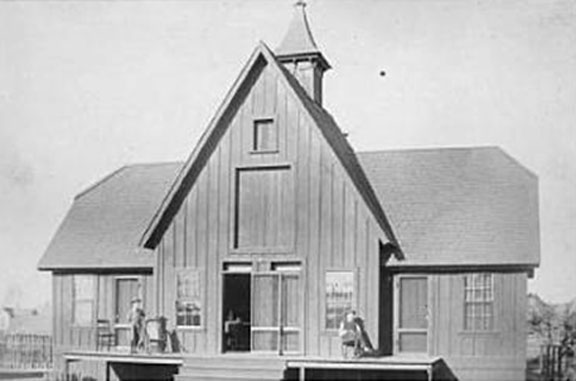
Cafe Pasadena with his 11:30 p.m. Wednesday guess "Well, it looks like early Pasadena in the late 1800s...Could easily be a tent or a barn since not much was built yet."

In the circa 1887 photo above, two adult males hang out on the back side of a barn that was used temporarily as living quarters.

During the building boom of 1886 to 1888, settlers were teeming to put down roots in the newly incorporated city. Many put up barns first -- some quite fancy architecturally -- and lived in them until homes could be built.

Pasadena looked like this in 1883 (looking north from Raymond Hill)...

...and like this seven years later (shot from the rooftop of the Hotel Green:

Here's an excerpt from my favorite local reference book, "Pasadena: Historical and Personal" by J.W. Wood, published in 1917, which can be found in the Centennial Room at Pasadena Central Library:


It was a strange overturning that began in 1886 and drove hitherto placid-minded, contented citizens to acts of frenzy and drew to the village of Pasadena thousands of boomers and speculators, turning the ordinary conditions topsy-turvy and firing the imagination of the most phlegmatic*...

...There had been occasional movements in real estate prior to the end of 1865. Now and then some one would drop into the village of Pasadena and buy ten or twenty acres of land and pay from $100 to $300 per acre, according as to whether improved and how. In 1886 there was a sudden stimulus; why, no one can exactly say. In 1887 Southern California, especially Los Angeles and Pasadena, was on the high plane of boom prices, and in 1888 -- the beginning of that year -- it had reached the climax: the blue, blue sky! Then it was
facilis decensus, indeed! leaving numerous putative "millionaires" stranded, financial wrecks -- dazed and amazed at the sudden and tragic conclusion of their dreams. This quick finish to their rose-hued visions was sickening and remorseless. 

* Tuberculosis was a big issue back then. See a related blog post here.


Many thanks to Pasadena Museum of History and Pasadena Public Library.

Tuesday, March 13, 2012

Mystery History

Where are we? And what's happening?

The first person to guess correctly will get free admission to LitFest Pasadena this coming Saturday!

I'll have the full scoop on Thursday.

Thursday, March 8, 2012

Mystery History -- Solved!

I'm giving my heart to Wanda for her 1:55 p.m. Tuesday guess "Maybe it is an initiation of some sort."

In the 1940 photo above, members of the Sorelle Club, a Pasadena City College sorority, look on as one of 14 prospective new members goes through the rite of initiation in a Pasadena barn.

The women's hair was smeared with molasses and raw eggs, they were dressed in nightgowns and masks, and made to smoke foul cigars and grovel on the barn floor.

After the humiliating hazing was complete, they were offically welcomed into the sorority during a formal ceremony:

When I was a senior in high school, I was initiated into the Belle Filles, a community service organization/junior sorority. The other candidates and I were blindfolded, taken to a very dark spot on Proctor Valley Road in rural San Diego County and made to kiss a severed cow's head on the lips without realizing what it was until the blindfolds came off (I knew it was something horrifying; turns out the father of one of the members owned a meat packing plant).

Thankfully, hopefully, this kind of hazing doesn't happen very often any more, if at all!

Many thanks to Pasadena City College.

Tuesday, March 6, 2012

Mystery History

Where are we? And what's happening?

The first person to guess correctly will win my heart (since I was still recuperating on Valentine's Day).

I'll have the full scoop on Thursday.

Thursday, January 26, 2012

Mystery History -- Solved!

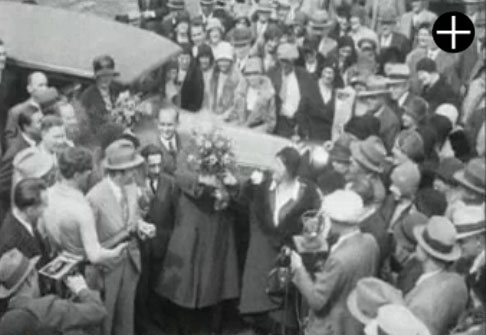
I stumped everyone this week. I thought that by showing a photo of the esteemed person holding flowers up, thereby blocking part of his face, someone would make the leap that it was Dr. E=MC2 himself.

In the 1932 photo above, Albert Einstein and his wife Elsa are given a huge send-off as they prepare to leave Pasadena after one of their sojourns here.

Here's a more revealing shot:

I did screen captures from a historic video that you'll find here.

In the early 1930s, Einstein spent three winters in Pasadena, living the first year in a bungalow at 707 S. Oakland Ave. During the following two winters, he resided at Caltech as a visiting professor and gave prominence to that institution and others. He spent his time working, lecturing and making public appearances here and throughout the greater Los Angeles area.

In January 1933, Einstein and Pasadena stood together as he made a national radio address from the stage of the Pasadena Civic Auditorium advocating for peaceful relations with Germany.

Here's a photo of him at the curtain that evening:

An answer came back only a few days later when Adolph Hitler became chancellor and the Nazi party made it clear that Einstein, a German and a Jew, would never be welcomed back to Germany. He never again set foot in his native land.

Here he's looking through a telescope at the Mount Wilson Observatory, accompanied by Edwin Hubble (center) and observatory director Walter Adams.

And here he's giving a talk at the Carnegie Observatories headquarters in Pasadena in 1931:

Many of Caltech's competitors in the annual Pasadena Collegiate Field Tournament have worn curly white wigs in tribute to the physicist:

In 2005 I co-produced a video titled "When Einstein Lived in Pasadena" to commemorate the 100th anniversary of his famous five papers. Institutions throughout the world hosted exhibits and special events throughout the year and traditional media and websites explored his life and career. The City of Pasadena won a national award for the video from the City-County Communications and Marketing Association (3CMA) that year.

The five groundbreaking papers set traditional scientific theories on their ears and sparked remarkable innovation that continues to this day. In the five papers, the 26-year-old patent clerk proved the existence of atoms, presented his special theory of relativity and put quantum theory on its feet.

When he was awarded his only Nobel Prize in 1921, it was for his work on the photoelectric effect, the basis for today’s quantum theory, which deals with the behavior of matter at the atomic and subatomic level.

These studies were just the beginning for Einstein, who went on to create the general theory of relativity (E=MC2) and to pioneer quantum mechanics.

Albert Einstein is considered the most significant person in the 20th century and one of the most brilliant minds in history.

And he was all ours for three winters in the 1930s.

Caltech has a nice site here.


Many thanks to British Pathe, Carnegie Observatories, Caltech and Corbis. The photo at the Pasadena Collegiate Field Tournament was shot by yours truly.

Tuesday, January 24, 2012

Mystery History

Where are we? And what's happening?

The first person to guess correctly will have sweet dreams.

I'll have the full scoop on Thursday.

Thursday, December 22, 2011

Mystery History -- Solved!

Gregg G wins with his 1:34 p.m. Wednesday guess "That isn't one of Phil Hawkey's Halloween costumes is it?"

In the photo above, former Pasadena City Manager Phil Hawkey emerges on the "bridge" at City Hall as Hawkman during a Halloween event for city employees on Oct. 27, 1994.

Hawkman stood for truth in government, justice for all employees and the Pasadena Way.

Every year Phil, aided by the inspiration of his wife Dena, would don a different getup and entertain employees who gathered in the courtyard at noon for a costume contest, refreshments and fun. It was a great employee appreciation event that continued throughout Cynthia Kurtz's tenure as city manager.

There was always a little skit. Here's Phil and yours truly in 1994:

Don't ask me what my costume was -- I don't remember! I guess I was dressed as a hag!

Phil's other costumes over the years included Count Hawkula rising from a coffin ("I'm not dead -- I just got a two-year contract!"). . .

. . .Philip Scissorhands the Budget Cutter, Biker Phil, Energizer Bunny Phil and more.

When Cynthia was city manager, she incorporated a contest for the best-decorated office lobby into the mix and even served as one of the judges.

Those days are gone now, but so many city employees have happy memories of Halloween fun.

Phil is executive vice president and professor of public administration at the University of LaVerne. Cynthia is president and CEO of the San Gabriel Valley Economic Partnership.

Our current city manager is Michael J. Beck, who hosts an ice cream social for employees every summer.


Many thanks to Pasadena Museum of History and Dena Hawkey.

Tuesday, December 20, 2011

Mystery History

Where are we? And what's happening?

The first person to guess correctly will be able to put a large feather in his or her cap.

I'll have the full scoop on Thursday.

Thursday, December 1, 2011

Mystery History -- Solved!


UPDATE: I always write up the big reveal well in advance and add the winner's name the night before it publishes. This week, with the wind storms and being called to duty, I didn't have a chance to announce that Roberta Martinez won this week's contest. Congratulations, Roberta!

=================

In the photo above, taken on Nov. 26, 1952, members of the Shakespeare Club of Pasadena pose in costume for the club's American Heritage Day pageant.

Left to right are Mrs. Don C. McMillan (wife of Pasadena's city manager at the time), Mrs. I. William King, Miss Helen C. Houson, Mrs. Anne Mellor, and Mrs. Harold Shirk.

Here are, left to right that same day, Mrs. Leo G. McLaughlin, past president, Miss Helen Louise Taylor, director of public affairs, Mrs. Arthur L. Howells, founder/chairman of the American Heritage Day Pageant and Mrs. Brown S. McPherson, president of the Pasadena Shakespeare Club.

This was when the Shakespeare Club was at 230 S. Los Robles Ave., its home from 1905 to 1971:

In 1972 the club moved to 171 S. Grand Ave.:

I had the pleasure of speaking to the club a few years ago about city issues during one of their monthly luncheon meetings there.

I included a photo of Mrs. McMillan in this blog post in June.

The Shakespeare Club of Pasadena is the oldest women's club in Southern California. There's some wonderful history here.


Many thanks to the Shakespeare Club of Pasadena, Pasadena Public Library and the University of Southern California.

Tuesday, November 29, 2011

Mystery History

Where are we? And what's happening?

The first person to guess correctly will win the respect and admiration he or she so richly deserves.

I'll give you the full scoop on Thursday.

Friday, November 25, 2011

Mystery History -- Solved!


Cafe Pasadena came closest with his 9:34 a.m. Tuesday guess "...this Pasadena officer is holding a dozen Roses & sitting in a wheelchair given to him by one of the nice people he gave a ticket for overnite or overtime parking, of all things!"

In the December 1951 photo above, able-bodied Pasadena Police Officer Robert Hultman uses a wheelchair as he marks car tires while smelling the lovely aroma of iconic Pasadena roses.

The wheelchair kept him low to the ground so he didn't have to bend up and down all the time.

Another officer would come around in an hour or two, check to see if any cars with marked tires were still there, and issue parking tickets accordingly.

The roses were delivered collect by what was believed to be an irate driver who had been ticketed for overtime parking.

Talk about your photo opp!

These days, the Transportation Department is charge of parking, not the Police Department.

Tuesday, November 22, 2011

Mystery History


Where are we? And what's happening?

The first person to guess correctly will sleep soundly in the knowledge that he or she is the smartest thing on the face of the planet.

I'll have the full scoop on Friday. (I know, it's usually Thursday, but that's Thanksgiving and I'll have a special post that day.)

Thursday, November 17, 2011

Mystery History -- Solved!


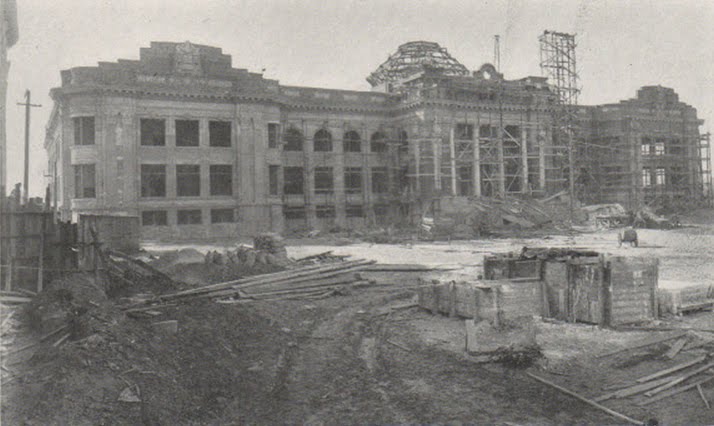
Well, I stumped everybody this week. In the 1934 photo above, demolition of the Horace Mann building at Pasadena High School is in full swing where Pasadena City College stands today.

There were orange groves and the old Grant School at the 18-acre site when construction of the PHS campus began, and the campus began to take shape the following year with three primary structures including the Horace Mann building.

Here's the Horace Mann building under construction:


And the completed structure:


This closeup shows the spectacular architectural elements:


And this aerial shot illustrates the huge scale of the building:


A population boom in Pasadena after World War I -- 45,000 grew to 76,000 -- created the need for major expansion of the school system. After the passage of a bond issue in 1924 for this purpose, the school board established Pasadena Junior College on the Pasadena High School campus.

The Field Act, passed by the California legislature after a series of earthquakes in the early 1930s, stated that governing bodies of school districts could be held criminally liable if students were injured in subsequent temblors. The report from a structural survey in July 1933 recommended that the Horace Mann building be stripped down to its steel frame.


After the demolition was completed, 50 temporary tents were set up to house classrooms.


There's much more detailed information here.


Many thanks to Pasadena City College and Pasadena Public Library.

Tuesday, November 15, 2011

Mystery History


Where are we? And what's happening?

I can no longer offer a fabulous prize from the City of Pasadena, but the first person to guess correctly will have the knowledge that the weekly virtual honor of being best and brightest will be coming his or her way!

I'll have the full scoop on Thursday.

Thursday, October 13, 2011

Mystery History -- Solved!


D5 rep wins with her 9:21 a.m. Tuesday guess "opening of the court house?"

In the Jan. 12, 1954, photo above, the Pasadena Municipal Court building in the civic center is rededicated in conjunction with its new ownership by the county of Los Angeles. Everyone is reciting the Pledge of Allegiance, led by L.A. County Sheriff Eugene W. Biscailuz.

A few years later, the county added the huge monstrosity that encompasses the L.A. County Superior Court to the north end of the historic building. That "modern" courthouse has been an eyesore in the stately Pasadena Civic Center ever since.

The exterior used to be red brick and gray concrete. It underwent a facelift couple of years ago, so at least it's a more neutral color.


I'll get more detailed with Mystery History reveals after Oct. 31, when I'll be back on a full-time basis.

Tuesday, October 11, 2011

Mystery History


Where are we? And what's happening?

The first person to guess correctly will win a fabulous prize!

I'll post the full scoop on Thursday.

Thursday, July 14, 2011

Mystery History -- Solved!


Bellis wins with her 3:55 a.m. Tuesday guess "The first traffic signal in Pasadena? I'm guessing the year could be 1910 or thereabouts, and the location Fair Oaks and Colorado."

The photo above was one of many taken to document the installation of new traffic signals in downtown Pasadena. Unfortunately the year and specific intersection are not identified.

Here's the best guess as to the date, according to Pasadena Public Library research staff:
This photo was taken for the Pasadena Water and Power Department (then called the Power Department), most likely to record the installation of new traffic signals. Although we can be certain that it was taken in Old Town Pasadena, the background is too blurry to suggest a definite location and date. However, one can reasonably use photo 5002 to establish a date for this photo. The two photos were clearly taken at the same time for the same purpose. Interestingly, photo 5002 also displays the same police officer so prominent in this photo.

And here's photo 5002, at Colorado Street and Fair Oaks Avenue:


The most recent traffic signal at the intersection of Madison Avenue and Orange Grove Boulevard was installed in May 2011 as part of an ongoing citywide effort to enhance pedestrian safety.

There was a big celebration in the street that day, followed by practice in safe street-crossing for the students at Madison School, which is just around the corner.

Here are children learning about the inner workings of traffic signals that day. That's Fred Dock, director of the Transportation Department, behind City Councilman Victor Gordo.


Learn more about pedestrian safety here.


Many thanks to Pasadena Public Library and Vannia De La Cuba.

Tuesday, July 12, 2011

Mystery History


Where are we? And what's happening?

The first person to guess correctly will win a fabulous prize!

I'll have the full scoop on Thursday.

Friday, July 8, 2011

Update on the Nishaiarai Daishi Temple Bell


Remember this Mystery History post from March about the centuries-old Japanese bell? It was war booty that wound up at Pasadena City Hall before being returned to the Nishaiarai Daishi Temple in Tokyo.

Thanks to Sid Gally, everybody's favorite research archivist at Pasadena Museum of History, I have an update!

Sid's son, Tom Gally, is a professor at the University of Tokyo and visited the temple last week. He provided these photos to his dad, who was kind enough to pass them on to me.


Tom even had this photo taken of himself with a monk holding the Pasadena Star-News, which I hope we'll see soon in the pages of the paper.


Bravo, Sid and Tom! Pasadena thanks you.

Wednesday, July 6, 2011

Mystery History -- Solved!


Chris Brandow wins with his 4:02 p.m. Tuesday guess "Busch gardens, maintaining the gnome decorations down in the arroyo."

In the 1933 photo above, an artist touches up sculptures of gnomes at the 30-acre Busch Gardens in Pasadena's Arroyo Seco.

Gnomes were featured at several locations on the property, including the Snow White exhibit shown in this colorized postcard...


...and gnomes fishing at the Mystic Hut:


Busch Gardens included 14 miles of pathways, 100,000 plants and shrubs, rare birds and more than 100 brightly painted sculptures imported from Germany, including Little Red Riding Hood.


Other popular spots at Busch Gardens included the Old Mill:


But the sheer scope and majesty of Busch Gardens was the ultimate draw, making it the most popular attraction in Southern California.


Adolphus Busch, president of the Anheuser Busch Brewing Association, came by train to Pasadena from St. Louis with his wife Lilly in 1904 and just weeks after arriving bought property on Orange Grove Avenue, which would come to be called Millionaires Row, overlooking the Arroyo Seco. The Busches built their winter home there, called Ivy Wall:


It had a sloping back lawn that went down into the Arroyo Seco.


Here are Adolphus and Lilly (center woman in black dress) at Busch Gardens:


Adolphus passed away in 1913 in Germany, where he and Lilly had a vacation villa. In the mid-1930s the property was subdivided into four parcels and sold to developers.

There are nice residential neighborhoods there now, with a few remnants of Busch Gardens infrastructure, including this portion of the original entrance (note the street name):


There's so much more to the Busch Gardens story than can be told here on my little blog, so I'll point you in the direction of additional information.

The Pasadena Museum of History hosted a very important exhibition in 2005 commemorating the 100th anniversary of the opening of Busch Gardens.

A series of very good descriptions of Busch Gardens and dozens of photo images can also be found here.

Pasadena Daily Photo blogger Petrea has posted about remnants of Busch Gardens, such as this one.


Many thanks to Pasadena Public Library and Pasadena Museum of History.