Showing posts with label 1930s. Show all posts

Thursday, January 26, 2012

Mystery History -- Solved!

I stumped everyone this week. I thought that by showing a photo of the esteemed person holding flowers up, thereby blocking part of his face, someone would make the leap that it was Dr. E=MC2 himself.

In the 1932 photo above, Albert Einstein and his wife Elsa are given a huge send-off as they prepare to leave Pasadena after one of their sojourns here.

Here's a more revealing shot:

I did screen captures from a historic video that you'll find here.

In the early 1930s, Einstein spent three winters in Pasadena, living the first year in a bungalow at 707 S. Oakland Ave. During the following two winters, he resided at Caltech as a visiting professor and gave prominence to that institution and others. He spent his time working, lecturing and making public appearances here and throughout the greater Los Angeles area.

In January 1933, Einstein and Pasadena stood together as he made a national radio address from the stage of the Pasadena Civic Auditorium advocating for peaceful relations with Germany.

Here's a photo of him at the curtain that evening:

An answer came back only a few days later when Adolph Hitler became chancellor and the Nazi party made it clear that Einstein, a German and a Jew, would never be welcomed back to Germany. He never again set foot in his native land.

Here he's looking through a telescope at the Mount Wilson Observatory, accompanied by Edwin Hubble (center) and observatory director Walter Adams.

And here he's giving a talk at the Carnegie Observatories headquarters in Pasadena in 1931:

Many of Caltech's competitors in the annual Pasadena Collegiate Field Tournament have worn curly white wigs in tribute to the physicist:

In 2005 I co-produced a video titled "When Einstein Lived in Pasadena" to commemorate the 100th anniversary of his famous five papers. Institutions throughout the world hosted exhibits and special events throughout the year and traditional media and websites explored his life and career. The City of Pasadena won a national award for the video from the City-County Communications and Marketing Association (3CMA) that year.

The five groundbreaking papers set traditional scientific theories on their ears and sparked remarkable innovation that continues to this day. In the five papers, the 26-year-old patent clerk proved the existence of atoms, presented his special theory of relativity and put quantum theory on its feet.

When he was awarded his only Nobel Prize in 1921, it was for his work on the photoelectric effect, the basis for today’s quantum theory, which deals with the behavior of matter at the atomic and subatomic level.

These studies were just the beginning for Einstein, who went on to create the general theory of relativity (E=MC2) and to pioneer quantum mechanics.

Albert Einstein is considered the most significant person in the 20th century and one of the most brilliant minds in history.

And he was all ours for three winters in the 1930s.

Caltech has a nice site here.


Many thanks to British Pathe, Carnegie Observatories, Caltech and Corbis. The photo at the Pasadena Collegiate Field Tournament was shot by yours truly.

Thursday, November 17, 2011

Mystery History -- Solved!


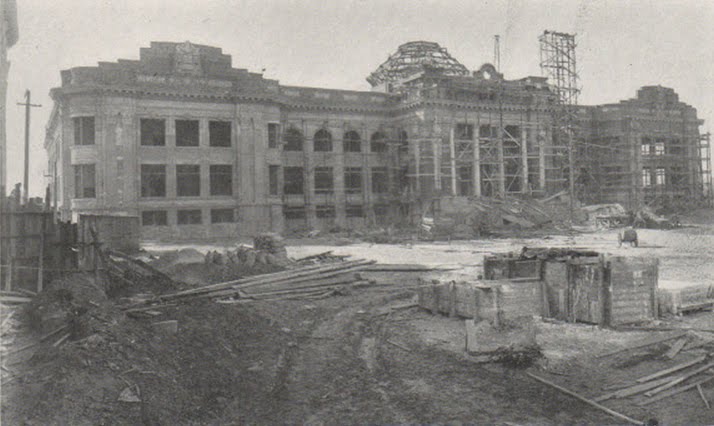
Well, I stumped everybody this week. In the 1934 photo above, demolition of the Horace Mann building at Pasadena High School is in full swing where Pasadena City College stands today.

There were orange groves and the old Grant School at the 18-acre site when construction of the PHS campus began, and the campus began to take shape the following year with three primary structures including the Horace Mann building.

Here's the Horace Mann building under construction:


And the completed structure:


This closeup shows the spectacular architectural elements:


And this aerial shot illustrates the huge scale of the building:


A population boom in Pasadena after World War I -- 45,000 grew to 76,000 -- created the need for major expansion of the school system. After the passage of a bond issue in 1924 for this purpose, the school board established Pasadena Junior College on the Pasadena High School campus.

The Field Act, passed by the California legislature after a series of earthquakes in the early 1930s, stated that governing bodies of school districts could be held criminally liable if students were injured in subsequent temblors. The report from a structural survey in July 1933 recommended that the Horace Mann building be stripped down to its steel frame.


After the demolition was completed, 50 temporary tents were set up to house classrooms.


There's much more detailed information here.


Many thanks to Pasadena City College and Pasadena Public Library.

Wednesday, July 6, 2011

Mystery History -- Solved!


Chris Brandow wins with his 4:02 p.m. Tuesday guess "Busch gardens, maintaining the gnome decorations down in the arroyo."

In the 1933 photo above, an artist touches up sculptures of gnomes at the 30-acre Busch Gardens in Pasadena's Arroyo Seco.

Gnomes were featured at several locations on the property, including the Snow White exhibit shown in this colorized postcard...


...and gnomes fishing at the Mystic Hut:


Busch Gardens included 14 miles of pathways, 100,000 plants and shrubs, rare birds and more than 100 brightly painted sculptures imported from Germany, including Little Red Riding Hood.


Other popular spots at Busch Gardens included the Old Mill:


But the sheer scope and majesty of Busch Gardens was the ultimate draw, making it the most popular attraction in Southern California.


Adolphus Busch, president of the Anheuser Busch Brewing Association, came by train to Pasadena from St. Louis with his wife Lilly in 1904 and just weeks after arriving bought property on Orange Grove Avenue, which would come to be called Millionaires Row, overlooking the Arroyo Seco. The Busches built their winter home there, called Ivy Wall:


It had a sloping back lawn that went down into the Arroyo Seco.


Here are Adolphus and Lilly (center woman in black dress) at Busch Gardens:


Adolphus passed away in 1913 in Germany, where he and Lilly had a vacation villa. In the mid-1930s the property was subdivided into four parcels and sold to developers.

There are nice residential neighborhoods there now, with a few remnants of Busch Gardens infrastructure, including this portion of the original entrance (note the street name):


There's so much more to the Busch Gardens story than can be told here on my little blog, so I'll point you in the direction of additional information.

The Pasadena Museum of History hosted a very important exhibition in 2005 commemorating the 100th anniversary of the opening of Busch Gardens.

A series of very good descriptions of Busch Gardens and dozens of photo images can also be found here.

Pasadena Daily Photo blogger Petrea has posted about remnants of Busch Gardens, such as this one.


Many thanks to Pasadena Public Library and Pasadena Museum of History.

Thursday, February 24, 2011

Mystery History -- Solved!


Nobody got it exactly right, but Bellis was the first person to name one person in the photo correctly with her 7:55 a.m. Tuesday guess "Mulholland and co. planning to buy up Hahamongna to bring water to LA? (after meeting fierce resistance from the Indiana colony, they headed up to Owens Valley)" so I'm giving her this week's fabulous prize.

Left to right in the 1931 photo above are Franklin E. Weymouth, William Mulholland and W.P Whitsett, and they're actually in the desert*. These three visionaries were responsible for bringing water from northern and central areas of the state to Southern California -- an intricate, expensive and bold move. They predicted that the future growth of Southern California -- Los Angeles, Orange, Riverside, San Bernardino, San Diego and Ventura counties -- would be tied directly to the capacity to import water from somewhere else.

And they were absolutely right.

Weymouth had been the chief construction engineer with the U.S. Reclamation Service (now called the Bureau of Reclamation) when he joined the team that conceived of the California Aqueduct. He was the first general manager and chief engineer of Metropolitan Water District of Southern California (MWD) from 1929 to 1941.

Mulholland was a self-taught engineer who had been responsible for the Los Angeles Aqueduct in 1913, which brought water from the Owens Valley to L.A.

Whitsett served on the board of the Los Angeles Department of Water and Power and was MWD's first chairman of the board from 1930 to 1947.

Today the California Aqueduct, managed by the California Department of Water Resources, is a series of canals, tunnels and pipelines that transport water from Northern and Central California to Southern California.


What's the significance of this week's Mystery History?

MWD is preparing for a seismic upgrade of its F.E. Weymouth Water Treatment Plant in La Verne (below).


From March 18 to 27 (and possibly longer), Pasadena’s water supply will be cut by 40 percent due to the temporary shutdown of a major regional water pipeline served by the treatment plant.

That's where you come in.


You won't be allowed to do any outdoor watering (with some exceptions) during that 10-day period, so here are some answers to frequently asked questions.

There will be a 7:30 p.m. public hearing at the Pasadena City Council meeting this coming Monday to declare a Level 4 water shortage emergency. The agenda will be posted here by tonight and you'll be able to attend the meeting in person or watch it live on KPAS (channel 3 on Charter in Pasadena and 99 on U-Verse) or via streaming video here (click on the KPAS logo)

We're all in this together!

*First time ever a Mystery History photo was not shot in Pasadena, but this was for a good cause.


Many thanks to MWD and Pasadena Water and Power.

Thursday, December 16, 2010

Mystery History -- Solved!


Bellis wins with her 10:02 a.m. Tuesday guess "Construction of a water tunnel at Devil's Gate dam?"

In the 1934 photo above, an unidentified man stands at the entrance of a water tunnel at the dam.

Here's the dam under construction in 1920:


Before construction began, Devil's Gate looked like this (see the devil's profile?):


I've done other Mystery History contests about Devil's Gate in the past. Learn more about its history here.


Many thanks to Pasadena Public Library.

Thursday, November 25, 2010

Mystery History -- Solved!


Mike wins with his 10:35 a.m. Tuesday guess "It is Spring Training at the baseball field at Brookside Park (now Jackie Robinson Memorial Field). Early 1930's. Folks on the left are Chicago White Sox players and the young ladies -- maybe the Rose Court?"

In the photo above, shot on March 9, 1938, by a Pasadena Post photographer, members of the Chicago White Sox baseball team toss oversized balls with some young women at Brookside Park during a media event.

The team was in town for their annual spring training, which was to have begun on March 3 but was delayed due to a serious flood.

Relentless heavy rains had poured over the L.A. region non-stop beginning Feb. 27. By March 3 a flood had spilled over the banks of the Arroyo Seco channel.

Damage to Brookside Golf Course was tremendous:


Luckily Brookside Park didn't fare as badly, but the baseball field was too soaked from the rains for White Sox play. Spring training began after it dried out a bit.

My very first Mystery History post was about the Chicago White Sox in Pasadena.

Happy Thanksgiving!

Many thanks to Pasadena Public Library.

Thursday, August 5, 2010

Mystery History -- Solved!


Last week I promised to go easier on you, and this week I did! So much so that Dianne nailed it right off the bat with her 10:13 a.m. Tuesday guess "That's my Jack Parsons in the Arroyo getting ready to do the test."

In the photo above, John Whiteside "Jack" Parsons stands in the upper Arroyo Seco on Nov. 15, 1936, with an experimental rocket motor.

Here's a photo of one of the motor tests on Nov. 28, 1936:


Parsons was born to wealth and privilege in Pasadena. From an early age he was a gifted chemist, self-taught explosives expert and had an obsession with the occult.

Parsons teamed up with aeronautical engineer Frank Malina and machinist Ed Forman to test a rocket motor they had thrown together from spare engine parts. After several unsuccessful attempts over the course of four days, the oxygen line unexpectedly ignited and started shooting fire, and the rest is history. Jet Propulsion Laboratory credits these early rocket motors as eventually evolving into the tools of spacecraft.

JPL has a nice little video on its website about these early days.

Here's a photo of Parsons (front right), Forman (back right) and Malina (third from left) along with students Rudolph Schott (far left) and Apollo Milton Olin Smith.


Theodore von Karman credited Jack Parsons's work in solid fuel research with making Polaris and Minuteman possible.

Parsons was only 38 years old on June 17, 1952, when an experiment in his home laboratory went bad and the whole place blew up. He died a few hours later.

Here's an L.A. Times photo showing a Pasadena police officer examining the post-blast rubble.


Rocket fuel from early testing seeped into some City of Pasadena water wells over several years, causing some of them to be closed off. In March 2009, Pasadena Water and Power began construction of the Monk Hill Groundwater Treatment Plant at the Windsor Reservoir near JPL. The new plant will remove perchlorate and volatile organic compounds from four deep wells in that area. It's a collaboration between the City of Pasadena and NASA, and is scheduled for completion this coming fall, when it will be able to treat 7,000 gallons of groundwater per minute, meet all regulatory stands and restore another source of safe drinking water to Pasadena.

Many thanks to JPL for the historic photos.

Thursday, July 22, 2010

Mystery History -- Solved


Well, people nibbled around the edges but didn't quite make it to this week's Mystery History solution.

In the photo above, chambermaids from the Hotel Maryland compete in a promotional bed-making contest in 1931.

There was a mad dash from the starting line:


Bed linens were flying as the chambermaids rushed to complete the task:


Pretty beds all in a row.


The winner with the fastest bed-making time: Blanche Scott.


Located on Colorado Street between Los Robles and Euclid, the Maryland was a resort hotel built in 1903. After it burned to the ground in April 1914, it was rebuilt (designed by Myron Hunt) and then demolished in 1938 to make way for The Broadway department store.

The hotel spanned from Walnut Street on the north to Colorado Street on the south, Los Robles Avenue to the east and Euclid Avenue to the west. The only remaining portions of the hotel are a building of condos on the northeast corner of Union and Euclid, and fountains behind All Saints Church that are now incorporated into Plaza las Fuentes.

A.M. Clifford was fire chief from 1901 to 1919.


From the Pasadena Fire Department website:
The Maryland Hotel fire turned out to be particularly difficult to extinguish, as a large natural gas line under the hotel continued to spew forth flame long after the hotel had burned to the ground. In spite of all efforts, the valve to shut off the gas could not be located until hours later, when it was found underneath a recently poured cement sidewalk.

Thursday, June 3, 2010

Mystery History -- Solved


Mike wins with his 7:21 a.m. Tuesday guess "We're at Burbank Airport. As for what's happening -- a Memorial Day airshow?"

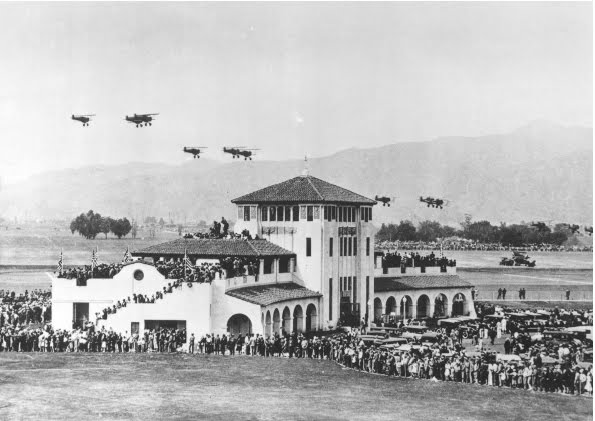
In the photo above, planes perform in an air show during grand-opening ceremonies at Burbank Airport on Memorial Day weekend in 1930.

Here's a photo that gives a better idea of the size of the crowd:


What's in a name? Dubbed Bob Hope Airport in 2003, it originally opened as United Airport in 1930, having been built by the forerunner of United Airlines. The name became Union Air Terminal in 1934 and was changed to Lockheed Air Terminal in 1940 when Lockheed Aircraft Corporation bought the airport. In 1967 Lockheed dubbed it Hollywood-Burbank Airport and it became Burbank-Glendale-Pasadena Airport in 1978.


An 80th anniversary banner was unveiled at the Bob Hope Airport last Friday and will remain in place throughout the summer.


The nine-member Burbank-Glendale-Pasadena Airport Authority, which owns and operates the airport through a joint powers agreement, has three members representing each city. Pasadena's members, appointed by the Pasadena City Council, are Joyce Streator (president), Chris Holden and Francis D. Logan. I replay airport authority meetings on KPAS Tuesdays and Thursdays at 10 p.m.

There was a special 80th anniversary celebration at Bob Hope Airport yesterday.

Many thanks to Victor Gill, my counterpart at Bob Hope Airport.

Thursday, December 10, 2009

Mystery History -- Solved


UPDATE -- He lives! Chris contacted me today (Friday) with his email address and blog address, so he indeed wins a fabulous prize. Thanks for proving me wrong, Chris!

* * *

Chris had the right answer, but the new rule is that if there's no way for me to contact the winner, there is no winner. The conspiracy theorist in me thinks "Chris" is a mole with an inside track. Please prove me wrong, Chris!

The caption for this photo in the June 15, 1936, edition of the Los Angeles Times reads:

Pasadena Junior College co-eds are shown forming living candles in this huge anniversary cake commemorating the fiftieth anniversary of the incorporation of Pasadena to be celebrated June 19. The girls are Evelyn Hansen, Ruth Nickerson, Barbara Lombard, Betty Wilcox, Peggy Munn, Ellen Jones, Marjorie Loomis, Helen Sperry, Mariam Purdon, Virginia Larsen, Joy De Long, Beverly Millar, Carol Crum, Patty McCune and Josephine Tryon. The cake is twelve feet in diameter.
On June 18 at the Rose Bowl Stadium about 50,000 spectators witnessed the major feature of the City of Pasadena's 50th anniversary observance: A combined commencement pageant for 2,487 new graduates of Pasadena Junior College, local high schools and junior high schools with the theme "The New Atlantis."

At this same event 100 city, county and school officials, accompanied by surviving pioneers, marched into the stadium and formed a human city seal featuring a rose crown. I've never found a photo of this but would love to come across it someday!

Here's a passage from the seemingly elitist Los Angeles Times on June 19, 1936:

It was on June 14, 1886, that the few thousand ranchers living in this area were notified that they no longer were "hicks," but resided in an incorporated city, or glorified dude ranch.
Here's something more dignified, written by J.W. Wood in his book "Pasadena: Historical and Personal" (one of my favorites in the Centennial Room at Pasadena Central Library).

Men and women may live for a long time in amicable social partnership and not feel the need of laws or miss the absence of edicts. But a time comes when a civic ambition stirs them, and necessity forces them to organize into a formal and legal partnership.

It was thus with Pasadena. Although there were some who declared against any necessity of it, events arose that compelled it. Pasadena was within the township of San Gabriel and the jurisdiction of its police court. I believe Otheman Stevens, known as the popular and able dramatic critic and special writer on a Los Angeles newspaper, for a time, administered Justice in the little court of San Gabriel. Little was there for him to do in a Judicial capacity which gave him the more time to practice with his pen.

He also was "regular correspondent" for the Pasadena Union and was thus exalted in the ranks of literary endeavor! But, as I said, San Gabriel administered our court of Justice. Pasadena wanted its own. Pasadena had no official existence yet, and no officials, excepting its School Trustees and a Deputy Constable.
Coincidentally, the Pasadena Star-News celebrated its 50th anniversary in 1936.


Many thanks to Pasadena Public Library and Los Angeles Public Library.