Showing posts with label 1950s. Show all posts

Thursday, December 1, 2011

Mystery History -- Solved!


UPDATE: I always write up the big reveal well in advance and add the winner's name the night before it publishes. This week, with the wind storms and being called to duty, I didn't have a chance to announce that Roberta Martinez won this week's contest. Congratulations, Roberta!

=================

In the photo above, taken on Nov. 26, 1952, members of the Shakespeare Club of Pasadena pose in costume for the club's American Heritage Day pageant.

Left to right are Mrs. Don C. McMillan (wife of Pasadena's city manager at the time), Mrs. I. William King, Miss Helen C. Houson, Mrs. Anne Mellor, and Mrs. Harold Shirk.

Here are, left to right that same day, Mrs. Leo G. McLaughlin, past president, Miss Helen Louise Taylor, director of public affairs, Mrs. Arthur L. Howells, founder/chairman of the American Heritage Day Pageant and Mrs. Brown S. McPherson, president of the Pasadena Shakespeare Club.

This was when the Shakespeare Club was at 230 S. Los Robles Ave., its home from 1905 to 1971:

In 1972 the club moved to 171 S. Grand Ave.:

I had the pleasure of speaking to the club a few years ago about city issues during one of their monthly luncheon meetings there.

I included a photo of Mrs. McMillan in this blog post in June.

The Shakespeare Club of Pasadena is the oldest women's club in Southern California. There's some wonderful history here.


Many thanks to the Shakespeare Club of Pasadena, Pasadena Public Library and the University of Southern California.

Friday, November 25, 2011

Mystery History -- Solved!


Cafe Pasadena came closest with his 9:34 a.m. Tuesday guess "...this Pasadena officer is holding a dozen Roses & sitting in a wheelchair given to him by one of the nice people he gave a ticket for overnite or overtime parking, of all things!"

In the December 1951 photo above, able-bodied Pasadena Police Officer Robert Hultman uses a wheelchair as he marks car tires while smelling the lovely aroma of iconic Pasadena roses.

The wheelchair kept him low to the ground so he didn't have to bend up and down all the time.

Another officer would come around in an hour or two, check to see if any cars with marked tires were still there, and issue parking tickets accordingly.

The roses were delivered collect by what was believed to be an irate driver who had been ticketed for overtime parking.

Talk about your photo opp!

These days, the Transportation Department is charge of parking, not the Police Department.

Thursday, October 13, 2011

Mystery History -- Solved!


D5 rep wins with her 9:21 a.m. Tuesday guess "opening of the court house?"

In the Jan. 12, 1954, photo above, the Pasadena Municipal Court building in the civic center is rededicated in conjunction with its new ownership by the county of Los Angeles. Everyone is reciting the Pledge of Allegiance, led by L.A. County Sheriff Eugene W. Biscailuz.

A few years later, the county added the huge monstrosity that encompasses the L.A. County Superior Court to the north end of the historic building. That "modern" courthouse has been an eyesore in the stately Pasadena Civic Center ever since.

The exterior used to be red brick and gray concrete. It underwent a facelift couple of years ago, so at least it's a more neutral color.


I'll get more detailed with Mystery History reveals after Oct. 31, when I'll be back on a full-time basis.

Thursday, June 16, 2011

Mystery History -- Solved!


Ben, our resident baseball guru, got it right off the bat (get it?) with his 6:30 a.m. Tuesday guess "Walter O'Malley checking out the Rose Bowl as an option to house the Brooklyn Dodgers."

In the 1957 photo above, National League President Warren Giles, Brooklyn Dodgers owner Walter O'Malley and Pasadena City Manager Don McMillan stand on the field of the Rose Bowl Stadium during contract negotiations that would enable the Dodgers to play at the stadium for up to two seasons during their transition to Los Angeles.

O'Malley, a real estate mogul, decided to move the Dodgers out of Brooklyn because the decrepit Ebbets Field was no longer a viable option for league play and his proposal for building a modern stadium in that burrough fell through when he could not get support for suitable land.

In May 1957 the National League approved the move to Los Angeles, and in October 1957 the L.A. City Council made it official.

But where would the newly named Los Angeles Dodgers play their 1958 season? And how about 1959?

O'Malley's grand plans for a stadium at Chavez Ravine couldn't take shape in time for a number of reasons that I won't go into here (look it up), so he and L.A. city officials turned to Pasadena to discuss a possible temporary home at the Rose Bowl Stadium.

Here from left to right, Los Angeles Mayor Norris Poulson, Pasadena Mayor Seth Miller and O'Malley pore over a map of the Rose Bowl Stadium on Dec. 11, 1957:


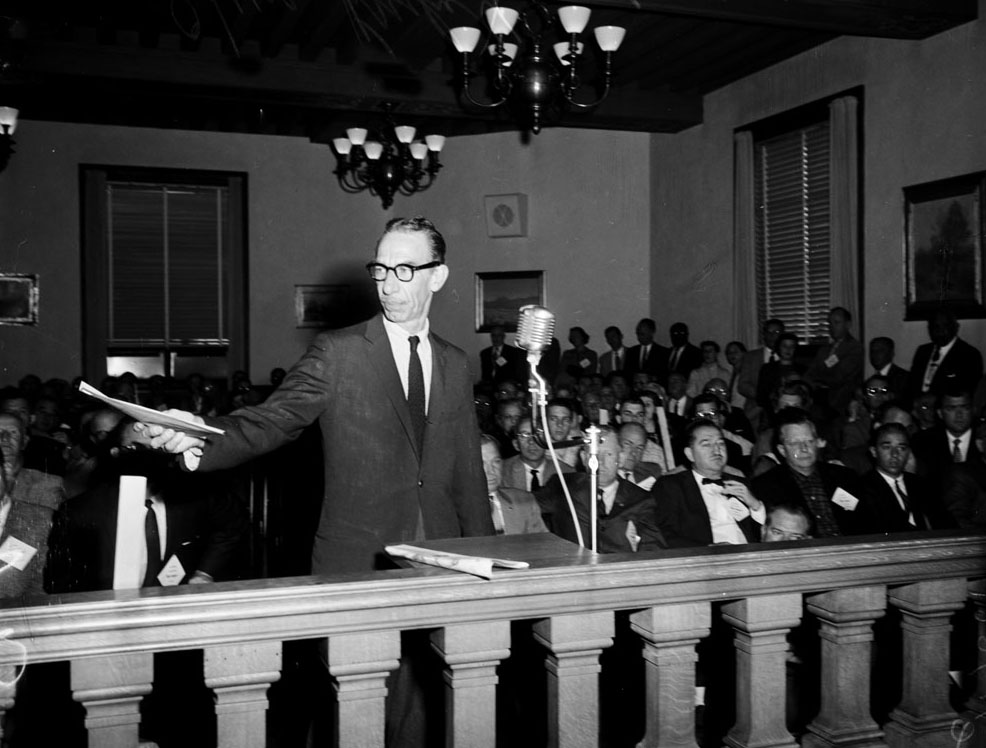
During the Dec. 17, 1957, meeting of the Pasadena Board of City Directors (now called the City Council), the chamber was packed with people, many in favor and many opposed to the Dodgers using the stadium.

Excerpt from the minutes of that meeting:
The Chairman announced that the matter of use of the Rose Bowl by the Brooklyn Dodgers would now be taken up and on the order of the Chairman, the City Clerk announced that to this hour, 150 letters were received expressing opposition to the use of the Rose Bowl by the Dodgers, which includes 5 organizations, and that 40 letters were received favoring the said use by the Dodgers which includes 9 organizations.

There was plenty of testimony in the chamber during the meeting.

Here's Oliver B. Prickett representing the Linda Vista Association in opposition of the proposal:


Richard Spaulding representing sporting groups in favor of it:


And James B. Wilcott speaking in favor on behalf of the Pasadena Quarterbacks:


Dozens of people gave their public testimony, for and against. After all was said and done:
Moved by Director Benedict,
"That we direct the City Manager to work out the details of a contract with Walter O'Malley for his Dodgers Baseball Club to use the Rose Bowl as a temporary location for a period of one and one-half to two seasons".

The motion passed six to one.

Excerpts from a Los Angeles Times article Jan. 6, 1958:
Walter O'Malley will climb aboard the Dodger merry-go-round again today, hopeful that he can grab the brass ring -- temporary tenancy for his big leaguers in the Rose Bowl.

This morning the Dodger prexy will resume his discussions with City Manager Don C. McMillan of Pasadena, which were broken off temporarily last month when O'Malley flew east to bring his family back to California.

Their initial negotiations merely were exploratory, but with time running out -- the Dodgers' first home game will be April 18 against the San Francisco Giants -- O'Malley realizes that he must get down to brass tacks.

There is some organized opposition to the Dodgers in Pasadena, principally from residents in the vicinity of the bowl. However, the bulk of the Crown City's citizenry, including leading merchants, labor groups, service and fraternal organizations, are enthusiastic about the prospect of hosting O'Malley's homeless waifs.

Joining O'Malley in his negotiations with McMillan and Rose Bowl Manager Bob McCurdy will be his legal eagle, Harry Walsh; Amos Buckly of the Allied Maintenance Co., Dick Walsh, assistant director of the Dodger farm system, and an engineer.

Business Manager Harold Parrott will be back at his Wrigley Field office today after a brief trip, and Vice President Buzzie Bavasi is expected to return from the East shortly.

Here are Don McMillan (left), Bob McCurdy, Warren Giles and Walter O'Malley going over tentative plans on Jan. 6, 1958:


But here's the thing: Just because a motion passes and negotiations begin, that doesn't mean a contract will actually be executed.

Los Angeles Times - Jan. 14, 1958:
After weeks of careful study the Dodgers' engineers reported that it would cost a minimum of $750,000 to transform the 100,000-seat Rose Bowl into a ball park of major league standards.

A joint statement issued by McMillan and O'Malley asserted that "this amount of money could not be amortized in a short-term, two-year lease." Furthermore, they agreed that "the alterations would leave physical scars on the beautiful Rose Bowl."

During the Pasadena discussions the Coliseum Commission declined to deal further with O'Malley, but some members said they would be willing to revive negotiations if the Rose Bowl plan failed.

The Dodgers would play four seasons in the Coliseum until Dodger Stadium opened on April 10, 1962.


Many thanks to Pasadena Public Library, the City Clerk's Office and USC.

Tuesday, June 7, 2011

Mystery History -- Solved!


I stumped everybody this week, although plenty of people provided clever guesses.

In the photo above, shot on Oct. 25, 1951, Pasadena City Manager Don C. McMillin accepts $2 from 7-year-old Bobby Bukshpan for a previously owned bicycle at the Pasadena Civic Auditorium during what was billed as the world's largest rummage sale. McMillin served as a volunteer cashier at the event, which was a benefit for the California Junior Republic Auxiliary.

I'll let these other photos speak for themselves:


Nowadays rummage sales aren't so popular. But plenty of people in Pasadena have yard sales on their properties. Remember, you need a permit! You can get two yard sale permits annually, each of which is good for up to three consecutive days.


Many thanks to USC.

Thursday, March 10, 2011

Mystery History -- Solved!


Carolyn wins with her 9:46 p.m. Wednesday guess "It's the bell that was WWII booty being examined by Warren Dorn and a visitor from the town in Japan that was going to get it back." (Carolyn, you didn't include contact info in your profile, so please e-mail me at aerdman@cityofpasadena.net and I'll tell you about the fabulous prize.)

In the 1955 photo above, Pasadena Mayor Warren Dorn (left) and Japanese Consul Tatsuo Iwama examine an ancient Buddhist bell in the grand entrance of City Hall.

The bell made its first public appearance in this country during an open house aboard the USS Pasadena on June 30, 1946, at the ship's home port of Long Beach.

The 1,300-pound bell, which had hung at the Nishiarai Daishi Buddhist Temple in Tokyo for centuries, was claimed by USS Pasadena sailors after they found it in a wartime scrap metal heap in Japan.

The ship donated it to the City of Pasadena, and it hung on display in the grand entrance of City Hall for nine years.

In this 1951 photo, Mayor Alson Abernethy and his secretary stand at the bell.


After Buddhist religious groups in Japan urged their government to demand the bell's return, the U.S. State Department got involved and smoothed the way.

In May 1955 the Board of City Directors (now called the City Council), headed by Dorn, authorized City Manager Don. C. McMillan to prepare a letter of disposition.

Here's the portrait of Mayor Dorn from the Hall of Mayors:


And Mayor Abernethy:


Pasadena Independent -- June 23, 1955:
Pasadena's controversial Japanese temple bell began the long journey home yesterday -- or did it?

Japanese Consul Tatsuo Iwama took delivery of the centuries-old relic from Mayor Warren M. Dorn in ceremonies at Pasadena City Hall at 10 a.m. But the moving men aren't scheduled to cart it away until 8:30 this morning.

The bell was hung in the rotunda since men of the cruiser USS Pasadena gave it to the city in 1946.

Serving as agent for the transfer is David P. Bushnell, Pasadena importer of Japanese binoculars, who announced receipt of the following telegram from Priest Hamano of the temple:

"Sincere appreciation your thoughtful service for hastening bell's return, from all our members and parishioners. Restoration ceremony will be held on arrival."

Donating their services in transporting the relic are Republic Van and Storage Inc., which will take it to Los Angeles Harbor; Packers Ltd., which will crate it; and the Daldo Line and General Steamship Corp. Ltd., which will carry it to Japan on the SS Kochi Maru.


Many thanks to the fine research staff at Pasadena Public Library.

Thursday, February 17, 2011

Mystery History -- Solved!


I stumped everybody this week.

In the photo above, golfers Wayne Griggs (left) and Gil Gentry play through despite a runaway car that had landed on the rim of a sand trap at Carmelita Park on Nov. 19, 1951.

Pasadena Star-News Nov. 20, 1951:
Golfers yelled "Fore!" for a runaway automobile at the Carmelita Park Pitch and Putt course yesterday.

The car belonged to Mrs. Jane Cheeseman, 77, of 150 South Oak Knoll Avenue who left it in the parking lot while she worked in the Red Cross building.

Somehow the car slipped its brakes and rolled 100 yards downhill into the eighth fairway where three golfers were carefully studying their approach shots. They scattered just in time and the car wound up in the sand trap, police reported.
Carmelita began as a huge private property owned by Dr. Ezra Carr and his wife Jeanne (more about that fascinating history here)

After the City of Pasadena took ownership of the land in 1941, the Carmelita Pitch and Putt course was established at the northeast corner of Colorado and Orange Grove boulevards.

Here are a couple of photos of the course, sans runaway cars:


Lofty plans originally calling for an extensive city park complete with a large, multifaceted cultural complex never came to fruition.

Today the property is owned by the City of Pasadena and leased by the Norton Simon Museum.


Many thanks to Pasadena Public Library and USC.

Thursday, October 14, 2010

Mystery History -- Solved!


I stumped everybody this week. The boxing photos threw many of you off.

In the photo above, a Pasadena police detective peers through the broken door of the "Assembly Room for Members Only" in the back of a Chinese Restaurant at 217 S. Fair Oaks Ave. on June 8, 1950, after a raid at that location.

Nearly 30 men and women were arrested after police broke through the door.

Some were arrested on suspicion of bookmaking, others for conducting gambling games on the premises, and the rest for being present while the city's antigambling ordinance was being violated.

Here's my favorite passage from the L.A. Times article that ran Jan. 10, 1950:
Police fired shotguns in preventing the crowd from "bolting" the raid. No one was injured.
Bookies, back-room gambling and vice raids...those were the days!


Many thanks to Pasadena Public Library and Los Angeles Public Library.

Thursday, September 30, 2010

Mystery History -- Solved!


Karin wins with her 9:06 a.m. Tuesday guess "Officials tour Wrigley Mansion, circa 1958. Donated to COP after Mrs Wrigley's death as permanent headquarters for T O Roses."

In the photo above, Pasadena Mayor Ray G. Woods (left), Tournament of Roses Association Raymond A. Dorn and Chairman of the TofR Board Max Colwell admire a crystal chandelier during a tour of the Wrigley Mansion on Oct. 13, 1959.

Here's the portrait of Mayor Woods from the Hall of Mayors:


Like so many eastern and midwestern captains of industry, William Wrigley Jr. (below), the chewing gum king and founder of the Wm. Wrigley Jr. Company, came to Pasadena every winter to escape freezing weather (he also had controlling interest in Catalina Island and had a spacious home there, as well as homes in other cities throughout the world).

The Italian Renaissance-style mansion was designed by architect G. Lawrence Stimson, son of George Stimson, a real estate and dry goods tycoon. After construction was completed in 1914, the elder Stimson sold the property to Wrigley (below) for $170,000.


After Wrigley passed away in 1932, Mrs. Wrigley spent most of her time in the Pasadena home, which had always been her favorite. When she died in 1958, the family donated the mansion and surrounding 4.5 acres of gardens and grounds to the City of Pasadena on the condition that it would become the permanent headquarters of the Tournament of Roses.


Now commonly known as the Tournament House, free tours of the Wrigley Mansion are offered every Thursday from 2 to 4 p.m. from February through August; once September rolls around, the mansion is closed to the public so Tournament of Roses officials, staff and volunteers can plan the Rose Parade and the Rose Bowl Game.

Many thanks to Los Angeles Public Library, Tournament of Roses and Wm. Wrigley Jr. Company.

Thursday, April 29, 2010

Mystery History -- Solved


Joseph wins with his Tuesday 8:27 a.m. guess "It's the Pasadena playhouse in 1959. Students are Colin Campbell and Lynn Preston. The instructor is Joseph Vince, if I'm not mistaken." But who are you, Joseph? The link goes nowhere, so please e-mail me to find out about your fabulous prize.

In the 1959 photo above, Pasadena Playhouse drama students Colin Campbell and Lynn Preston learn fencing tips from master instructor Joseph Vince, who had been a U.S. fencing champion in the 1920s.

The Pasadena Playhouse got its start in 1917 and opened for business in its present location in 1925 after the citizens of this community contributed a whole lot of funding.

It has a long history of being the "Star Factory" where renowned actors including Gene Hackman, Dustin Hoffman, Victor Mature and Raymond Burr got their training.

More recently, the Playhouse closed its doors -- temporarily, we all hope -- due to funding issues.

The City of Pasadena owns the building, which was designed by architect Elmer Grey.

Many thanks to the University of Southern California.

Thursday, April 22, 2010

Mystery History -- Solved


Kevin wins with his 9:11 p.m. Wednesday guess "Judging by the vinyl LPs, I would say it is early 1960s. I think a deer ran through her house. Notice how none of the plant vegetation is around the plant except for one leaf that fell quite away from the dirt. The deer may have eaten the plant. The ironing board was knocked over too. The iron is under the far chair. The deer probably took the ironing board when it left. It would make a perfect deer-shaped sleeping platform out in the woods."

(Karin was on the right track with her 3:33 p.m. Tuesday guess "It can't be a quake -- look at the lamp and the records. How about an animal ran through the house -- a raccoon or a bear" but there are no second-place prizes in Mystery History.)

In the photo above, taken April 15, 1955, a distraught Betty Reed and her cat survey her wrecked living room after a 150-lb. male deer crashed through the window.

Here she is at the window with her five-year-old son Jay (and that darn cat):


Turns out the buck had come down from a nearby hillside to the residential neighborhood. But soon it caught the attention of a dog, which began barking loudly and frightened the poor thing to the point where it went berserk.

The buck also smashed through a window of the Reeds' next-door neighbor Jeanne Davis, in this photo with her daughter Virginia:


It wasn't long before Officer William Paisley of the Pasadena Police Department and Officers Cecil Fraser (left) and Howard Bishop of the Pasadena Humane Society arrived. Since the buck had become a threat to safety, they decided on a swift course of action.


It was pronounced dead at the scene. The neighborhood kids were awe-struck.


Many thanks to the University of Southern California.

Thursday, April 15, 2010

Mystery History -- Solved


Tammy wins with her 9:51 a.m. Tuesday guess "Welcoming Mishima as Pasadena's sister city."

Her answer is not quite specific enough, but that's OK, I'm easy. In the photo above, shot in May 1958 in the council chamber at Pasadena City Hall, Mayor Seth Miller receives a gift from Japan Airlines stewardess Nobu Atsumi as a prelude to an open house the next day during which Pasadena's sister city of Mishima, Japan, would exhibit arts and crafts.

Mishima was adopted as our second sister city in 1957 (Ludwigshafen, Germany, was the first). President Dwight D. Eishenhower founded the Sister Cities program in 1956 to achieve international peace through a people-to-people concept of "twinning" U.S. cities with foreign communities throughout the world.

Here's the portrait of Seth Miller from the Hall of Mayors.


Seth Miller's family arrived in Pasadena in 1919 when he was 9 years old. As an adult he owned an automotive business for many years.

He was elected to the Board of City Directors in 1951. In 1955 he became vice mayor. Then, in 1956 -- during the long period when mayors were elected by fellow council members on a rotation schedule -- he became mayor five months ahead of
schedule following the resignation of Warren M. Dorn, who had been elected to the Los Angeles County Board of Supervisors. Miller served as mayor until 1959.

He passed away in 1967.

Friday, April 2, 2010

Mystery History -- Solved (Really)


Bellis wins for her 2:34 p.m. Wednesday guess "Fire at the Orban Lumber Yard at the corner of Green Street and Pasadena Avenue on the 23 March 1958. Sad to see so much wood go up in smoke."

Sure enough, in the photo above, the place went up in a blaze of glory after 54 years of business.

This was no small incident, as evidenced in these photos:


The fire was in the pre-dawn hours of March 23, 1958.

Established in 1904, Orban Lumber was a fixture in town until the fateful night of the devastating fire. It was founded by Peter Orban, who became a prominent Pasadena businessman active in the Chamber of Commerce. Orban Lumber expanded into Whittier in 1913 and the Inland Empire soon after.

Pasadena was incorporated as a city in 1886 and the Pasadena Fire Department was established the following year with a whopping budget of $1,000.

It took a little time to get the ball rolling. The event that started it all was in 1885 when some boys threw a stone into a building that was being used by Chinese immigrants as a laundry. The stone tipped over a kerosene lamp, starting a fire that burned the building to the ground.

Here's a photo circa 1910 of a horse-drawn fire wagon in Central Park.


Pasadena's very first fire station was on Dayton Street between Fair Oaks and De Lacey. The building still stands today at 37 W. Dayton St.


The Pasadena Fire Museum is at Station 31, 135 S. Fair Oaks Ave. right across the street from Central Park and around the corner from that first station. Stop by sometime and take a look at the historic photos and other memorabilia.


And be sure to say hello and thanks to the firefighters while you're there!

Thursday, March 11, 2010

Mystery History -- Solved


I stumped everybody again this week. It was hardly fair, actually, because as I mentioned in the original post, looks can be deceiving.

In the photo above, shot November 20, 1951, U.S. Marine T/Sgt. James B. Nash Jr. visits with Pete Meston, 13, of the Wilson Junior High School Band.

I told you this one would probably throw you. Here's why.

Nash wasn't a Pasadenan; he was from Durham, North Carolina, and had been awarded the Silver Star while fighting in the Korean War.

He was at Pasadena City Hall along with 23 soldiers from 18 nations who traveled around the country on a United Nations tour to bring attention to the importance of donating blood and purchasing defense bonds.

The GIs were from Australia, Belgium, Canada, Colombia, England, France, Greece, India, Korea, Luxembourg, the Netherlands, Norway, the Philippines, South Africa, Thailand, Turkey, New Zealand and the United States of America.

Mayor Alson Abernethy greeted each one personally.


Here's an excerpt from the Pasadena Star-News:

The flags of 18 nations flew in the City Hall plaza today when 23 decorated soldiers of the United Nations fresh from the fighting in Korea stopped in Pasadena on a nationwide tour.

They came to the Crown City, a living demonstration of United Nations' unity, as part of a coast-to-coast drive to stimulate contributions to the Red Cross blood bank and the sale of defense bonds.

Police cars escorted the cavalcade of automobiles into the plaza while the Wilson Junior High School band serenaded from the City Hall steps. Each car bore the name and nation of its occupant on its doors, from the front left fender of each car flew the U.N. flag and from the front right fender flew the national colors of each soldier.

Mayor Alson E. Abernethy termed the visitors "veteran heroes of Korea" in his welcoming remarks.

He told them of another Korea veteran, Marine Cpl. Bob Gray, who was grand marshal of last January's Tournament of Roses parade.

"He not only won the hearts of 1,500,000 people, but he won the heart of one of our fairest princesses," Mayor Abernethy said, referring to Corporal Gray's marriage to Rose Princess Betsy Josi.

"If you could stay longer maybe we could fix you up, too," he said.

The mayor said he knew the veterans would "be bombarded by more mayors than they were by shells in Korea" during their tour, so he ended his brief remarks with a simple reminder that "the mission you are on now is as important as any you have had in the past."

All of the 23 sailors, soldiers and airmen in the group, sponsored by the Defense Department, were recipients of medals in the Korea war...
Cpl. Robert S. Gray was the grand marshal of the parade on Jan. 1, 1951, after Gen. Dwight D. Eisenhower, then president of Columbia University, had to bow out when he returned suddenly to military duty to assume command over NATO forces. As a last-minute replacement, Eisenhower and the president of the Tournament of Roses Association wanted to pick an active duty U.S. military man who had been wounded in service to his country. What a great honor for this young Marine, who represented all of the armed forces in Korea as he waved to the crowds.


And here's the Rose Queen and her Royal Court. I don't know know which one is Betsy Josi. I do know it was a whirlwind romance: They were married March 30, 1951.


In keeping with my tradition, here's the portrait of Mayor Abernethy from the Hall of Mayors:


Many thanks to Pasadena Public Library and Tournament of Roses Association.