Tuesday, August 31, 2010

Mystery History


Where are we? And what's happening?

The first person to guess correctly will win a fabulous prize!

I'll have the full scoop on Thursday.

Monday, August 30, 2010

...We All Scream for Ice Cream!


Two days after an ice cream social at City Hall for employees, the city manager hosted another one for employees who work at the City Yards on the north side of Mountain Street just east of the 210 Freeway. This is where many of the operations for the Public Works Department and Pasadena Water and Power are carried out.

They waited in line patiently in the sweltering heat:


But it was worth it!


Servers included (left to right) Public Works Director Martin Pastucha, Public Libraries Director Jan Sanders and City Manager Michael Beck.


Also serving were Shari Thomas, Eric Klinkner and Joe Awad, all assistant general managers for Pasadena Water and Power.


Many thanks to Michael Beck.

Friday, August 27, 2010

I Scream, You Scream...


City Manager Michael Beck's ice cream social for employees Tuesday was a big hit on a very hot day. The servers were mostly members of the executive staff.

In the photo above, Fire Chief Dennis Downs and his executive secretary, Peggy Palmer, stand at the ready to scoop the creamy confectionery at this second annual event.

Below, left to right, are Assistant City Manager Julie Gutierrez, City Attorney Michele Bagneris, City Clerk Mark Jomsky, Housing Director Bill Huang, and Patty Sierra, a summer employee in the Housing Department.


Here are Assistant City Manager Steve Mermell (second from right) and Police Chief Phil Sanchez.


And, of course, city employees appreciated having a tasty treat in the shade of the City Hall courtyard.


Many thanks to Delia Corey, executive assistant to the city manager.

Thursday, August 26, 2010

Mystery History -- Solved!


Susan wins with her 7:07 a.m. Tuesday guess "It's the Rose Bowl hoax of 1961, when 14 Caltech students changed the Washington Huskies halftime card stunt to read Caltech."

Sure enough, in the photo above, unsuspecting Washington Huskies football fans hold up flip cards they believe spell out "HUSKIES" during halftime ceremonies at the Rose Bowl Game on Jan. 2, 1961*.

But the joke was on them because several Caltech students, calling themselves "The Fiendish Fourteen," hatched a week-long plan for carrying out a brilliant hoax in front of a sold-out stadium crowd and an estimated 30 million television viewers.

The University of Washington football team, shown here with their coaches, had no idea the stunt was being planned.


Details of the hoax are much too long and complicated for me to run down here on my humble little blog.

According to Caltech, "It has emerged as the standard against which all other pranks are compared, and has never been equaled, let alone surpassed."

The complete, most accurate background is available on the Caltech website here.

The hoax made the cover of Caltech's Engineering and Science publication that month:


That article made local news that was picked up by the Associated Press, which led to the background on the hoax being printed in newspapers around the world.

Excerpt from the Jan. 25, 1961, AP article:

The secret of how California Institute of Technology pranksters tricked University of Washington students into spelling out "Caltech" for a nationwide TV audience at the last Rose Bowl game was laid bare Thursday.

The current issue of Caltech Magazine, engineering and science, carries a story by Lance Taylor, class of 1962, which outlines the almost incredible preparation and ingenuity required.
The article goes on to report the sequence of events, which began before Christmas.

Here's the cover of the program for the 1961 Rose Bowl Game.


The Huskies must have taken some comfort from winning the game 17-7. The Huskies have had seven Rose Bowl wins.

Caltech students have been renowned for their pranks over the years:

• In 1977 Caltech grad Bruce Montgomery inscribed "DEI/FEIF" onto the valve package he designed for each of the Voyager missions. It was a nod to the long-time Dabney Eats It/Fleming Eats It Faster fraternity rivalry.

• In 1984 some students hacked into the Rose Bowl Game scoreboard at halftime and changed it to read "Caltech 31, MIT 9" (UCLA was playing Illinois).

• In 1987 Caltech students modified the Hollywood Sign:


• In 2005 Caltech students stealthfully superimposed the names of hundreds of illustrious scientists onto stars on the Hollywood Walk of Fame in honor of a commemorative U.S. postage stamp of late Caltech physicist Richard P. Feynman.


Many thanks to Pasadena Public Library, Caltech and the Tournament of Roses Association

* Whenever Jan. 1 falls on a Sunday, the parade and game are the following day.

Tuesday, August 24, 2010

Mystery History


Where are we? And what's happening?

The first person to guess correctly will win a fabulous prize!

I'll have the full scoop on Thursday.

Friday, August 20, 2010

Looking at Something-or-other on My Conference Table


During a meeting in my office today, Michael Beck (left), the mighty Zack Stromberg, Robert MontaƱo and I pored over some designs for something that will be revealed to you in time.

Michael is the city manager, Zack is my graphic designer in the Public Affairs Office and Robert is a project planner in the Economic Development Office.

Thursday, August 19, 2010

Mystery History -- Solved!


I'm calling a tie on this one: (1) Trish for her 11:29 a.m. Tuesday guess "can't remember her name...ugh, brain fail. But behind her, welding work being done on the queen/court float for the parade" and (2) Roberta for her 11:37 p.m. Wednesday guess "Isabel Coleman?"

In the photo above, Isabella Coleman stands in front of the steel framework for San Diego's 1965 Rose Parade float titled "World Peace."

Here's the finished float in the parade:


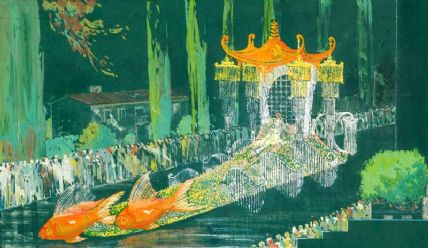
It was one of the final works of the veteran float designer whose career spanned 60 years.

Isabella Coleman was a visionary who was single-handedly responsible for changing the look of the Rose Parade.

In the early days of the Tournament of Roses, before the turn of the century, the parade featured horse-drawn wagons with a few roses and other flowers woven or tied to them.

Along came "Izzy," who in 1909 created the technique of gluing individual flower petals -- thousands of them -- on a single entry.

She later pioneered many of the techniques for animation and elaborate detail that float designers still use today; and she was the first to pitch ideas for floats to corporate sponsors that would fund the work.

Here she is in 1915 with some of her awards for float design:


During the Great Depression, when her banker husband was out of work, it was her float designs that kept the family, er, afloat.

For each float she drew dozens of sketches, then hired commercial artists to create renderings. She stored the sketches and renderings under rugs in her home to keep them flat and save space.

The drawing of her 1936 float for Standard Oil of California was before its time:


Here's Izzy next to her 1960 Occidental Insurance float under construction.


Detail of the same float, later on:


All told, she designed more than 250 award-winning Rose Parade floats over the course of her career.

The Smithsonian Institution's National Museum of American History has an ongoing exhibition titled "Holidays on Display" that features Isabella's work.


Five years after she retired, the Tournament of Roses honored her by adding a new float award: the Isabella Coleman Trophy for best presentation of color and color harmony through floral use.

She remains the most respected float designer in history.

For you local history buffs, her father was C.V. Sturdevant, a Pasadena realtor and developer.

Excerpt from one of my favorite books in the Centennial Room at Pasadena Central Library, "Pasadena: Historical and Personal" by J.W. Wood:

So it would seem that despite the "late disturbance" the town was altogether in desperate straits. The Board of Trade Directors, then as now, met now and decided that "something should be done" to promote progress, etc. Due attention must be given to the fact that the "Colony" had outgrown its swaddling clothes, and had become a regularly incorporated "City" of the sixth class, which, under California laws, meant that it was managed by a Board of Trustees, with a Chairman whose duties corresponded with those of Mayor and City Council under a more expanded system.

One of the things that counted after the boom wreck had been cleared away, was the efforts made to improve the street by cleaning up, sprinkling them and in cases, paving them. Scarcity of water, at times, scarcity of money, always, retarded street sprinkling and the dust was frequently intolerable. The wide awake real estate agent realized the drawbacks in these conditions and urged their correction.

I remember particularly the endeavors in the direction made by such agents as C. V. Sturdevant in the Los Robles, Galena and other streets in the northeast section. Sturdevant labored for two or three years to bring about better street conditions and saw them completed at last.


Many thanks to the Tournament of Roses Association and the Smithsonian Institution.