Showing posts with label 1900s. Show all posts

Wednesday, June 29, 2011

Mystery History -- Solved!


I stumped everybody this week, although there were some very clever and creative guesses!

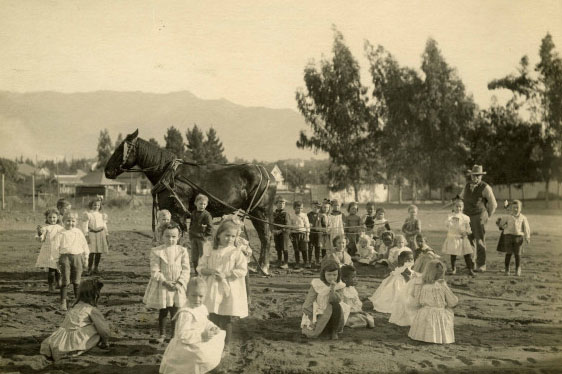
In the 1903 photo above, young students plant gardens at James A. Garfield Elementary School.

The school, at what is now the northeast corner of Pasadena Avenue and California Boulevard, was designed by the firm Ridgeway, Stewart and Son in the Anglo-Teutonic style.


It opened in 1888 on a large property that included gardens and orchards planted and tended by students (with supervision, of course).


In their 1902 book "The World's Work: A History of Our Time," Walter Hines Page and Arthur Wilson Page wrote:

The Garfield school at Pasadena, California, is again conspicuous for its masses of pink ivy-geraniums over the stone wall which supports the sloping lawn, its beds of pink and white geraniums, its clusters of rose bushes and palm trees. In New York, limited space has prevented extensive gardens but an occasional playground is oulined by a hedge of green.

With Pasadena’s population boom in the late 1800s, additions were built on the campus, including this charming kindergarten building that opened in 1902:


I love this photo of kindergarteners learning woodworking skills on one of the building's porches:


Garfield School is long gone (a Vons shopping center is there now). These hale and hearty young boys bid you farewell.


Many thanks to Pasadena Public Library and Pasadena Museum of History.

Thursday, May 5, 2011

Mystery History -- Solved!


Daniel wins with his 7:54 p.m. Tuesday guess "Blacker House garage under construction." (Daniel, you didn't include any contact info, so please e-mail me at aerdman@cityofpasadena.net and I'll tell you about your fabulous prize!)

In the 1907 photo above, workers near completion of the garage at retired Michigan lumber magnate Robert R. Blacker's estate while landscaping materials are brought in.

Charles and Henry Greene were meticulous about every aspect of the house's and outbuildings' designs, including the garage:


Here's the house under construction:


Teak, mahogany and ebony were used. Total cost of the project was $100,000 -- a whopping amount of money at that time.

Los Angeles Times, May 10, 1908:
As Mr. Blacker, the owner, is an old lumber man, he has taken great pride in having the best material obtainable for the house. Days and weeks have been spent in securing timbers which would suit his taste. The exterior works consists of a great deal of detail work obtained by cross timber work and wherever there is an exposed beam this is absolutely perfect, without a knot or chuck. Hand-wrought iron fastenings hold these timbers in place and will be allowed to rust to get the desired effect. Hammered copper sheets, formed into gutters and ducts, lead the rain water to the cement drains and are tarnishing to an aged look.

The E.O. Nay Company got the plumbing contract for the buildings and grounds.

For many years the Blacker House, with its seven-acre grounds, gardens and ponds, was the crown jewel of the Oak Knoll subdivision in the early 20th century.


(Robert Blacker died in 1931. After his wife Nellie passed away in 1946, the acreage was parceled off into smaller lots.)

As was the case with the Gamble House, Greene & Greene designed everything from the exterior to the furniture and fixtures.

Unfortunately, in 1985 the house was sold to a Texan who didn't have the appreciation of this monumental feat that the rest of the world does. He perpetuated the so-called cultural rape of the Blacker House, selling off to private collectors and institutions more than 50 leaded art-glass light fixtures, doors and panels that were all custom-designed by Greene & Greene for this particular home. They were, as the Los Angeles Times put it, "sold off as body parts":
...Some of the lamps fetched $100,000 each, and at least one of the more imposing chandeliers sold for about a quarter of a million dollars. A handful of fixtures was sufficient to cover the price of the house. (Mr. English declined to give figures.)

Pasadena citizens, including Mr. Makinson*, loudly declared their outrage, and with the support of Pasadena Heritage, a preservation group, the city passed an emergency ordinance that slowed further removal of the pieces. Citizens guarded the house in cars parked out front.

Mr. English sold the Blacker House in 1988, never having lived in it. The removal of the fixtures had violated the integrity of Greene & Greene's design. The brothers had created interiors that were symphonies of carefully orchestrated parts, and suddenly the first violin section was missing in every room. One of the finest works of American architecture had been desecrated...

Enter Harvey and Ellen Knell. They bought the Blacker House in 1994 and immediately set their minds to restoring it to the best extent possible. They worked with Mackinson, master craftsman James Ipekjian, Hamm Glass Studios and other specialists who replicated the sold-off fixtures and restored the house inside and out.


After four years of restoration, a benefit dinner hosted by actor Brad Pitt celebrated the completion of the project. The Blacker House had finally regained its state of grace intended by the Greene brothers.

Here's the Blacker House today:


It was listed in the National Register of Historic Places in 1986 and is an important component of the annual Craftsman Weekend organized every October by Pasadena Heritage.

I could get into much more detail and history, but I'll leave it you to learn about. The Gamble House has a couple of web pages devoted to the Blacker House here.

"Greene & Greene: The Blacker House" is an excellent book if you want to learn even more (way more!) about it.

You can also drive by the Blacker House -- the Knells wouldn't mind. It's at 1177 Hillcrest Ave.


* Randell Mackinson of Pasadena is a historic restoration architect with a specialty in Greene & Greene.

Many thanks to Pasadena Public Library, Randell Mackinson, the Gamble House, Hamm Glass Studios and Hometown Pasadena.

Thursday, March 24, 2011

Mystery History -- Solved!


Cafe Pasadena wins with his 6:42 p.m. Tuesday guess "Early 1900's foto of a grocery/bakery on 679 S.Fair Oaks here in Pasa. I pass this block regularly in search of, I don't know what. Was owned by Carrie McAdoo, widow of Booker. This is basically across from Huntington Hosp."

In the 1909 photo above, McAdoo Grocery is open for business on West Colorado Street.

Inside the store:


Booker McAdoo, his wife Carrie Woods McAdoo and their three children came to Pasadena from Hot Springs, Ark., by way of Riverside, in 1899. Booker had worked all his life as an attendant in a bath house and massage parlor. After he contracted tuberculosis, his doctors recommended a move to California.

In Riverside he worked hard as a laborer in the orange groves, which made his medical condition worse. He and Carrie decided to move to Pasadena and open a business.

Early images of Booker...


...and Carrie:


When the McAdoos first came to Pasadena, they owned a restaurant that Carrie managed on her own due to Booker's failing health.

Later they opened a grocery store at 53 S. Fair Oaks Ave. It was the first grocery owned by African Americans in Pasadena.

After Booker passed away, Carrie closed the store and opened a larger one at 670 S. Fair Oaks Ave. She was 37 years old at the time.

Excerpt from the 1977 oral history of their son, Benjamin Franklin McAdoo:
She was pretty young, so she wanted to get permanently located. We bought property and she moved in two buildings and got things started and we began there with our grocery store. It was very prominent because people all around in the neighborhood would come there to buy.

Here's Ben with Stella, one of his two sisters:


Carrie and her family operated the McAdoo Grocery at 670 S. Fair Oaks Ave. until 1907 when the San Gabriel Valley Investment Company, an African American financial concern, bought the business.

Ben:

Then a black corporation was formed here in town called the San Gabriel Valley Investment Company and they bought the store out. They started to operate the store. They did a wonderful business, but there was some dishonest employees and that ruined the business. That was their end.

Carrie bought back the business in 1909, closed it right away and opened a larger store on West Colorado Street. The McAdoo family operated the store in that location until 1911.

Ben:

Then we sold out to Caucasian people. I don't know how long they ran it or where they moved to. I've forgotten about that.


Ben had a long and fascinating history of his own, which perhaps I'll tell one day.

For now, I leave you with this wonderful photo of Carrie in her golden years, surrounded by her grandchildren:


I would love to say that's Carrie in the top two photos, but the woman isn't identified. I say it's her. What say you?

Nowadays the City of Pasadena offers free workshops monthly to owners and managers of small businesses. The next one is Tuesday, April 12, with the theme "Great Customer Service: Acquiring and Expanding Your Customer Base." See more information here.


Many thanks to Pasadena Museum of History, Pasadena Public Library and Pasadena Heritage.

Thursday, April 8, 2010

Mystery History -- Solved


I stumped everybody again, although everybody was close in one way or another.

In the circa 1910 photo above, Hanhichi Wakiji, front right, poses with staff at the Nippon Nursery at 1505 E. Orange Grove, which he founded in 1905.

Born in 1876 in Japan, he set sail in 1895 for San Francisco where he worked as a houseboy before coming to Pasadena. He was only the second Pasadena pioneer born in Japan (Toichiro Kawai was the first).

With so many hotels and mansions being built by and for wealthy captains of industry from the east coast, Hanhichi saw a need and capitalized on it.

After learning the trade from the owner of Rust Nursery Company in South Pasadena, he founded his Nippon Nursery Company with two partners who soon after moved back to Japan, after which he bought them out and became sole proprietor.

Nippon Nursery provided palms, ferns, roses, evergreens and ornamental trees to hotels and middle- to upper-class residential properties throughout Pasadena and Altadena. It became a thriving enterprise and Hanhichi a prominent businessman.

La Pintoresca Hotel at the northeast corner of Fair Oaks and Washington was one of his many clients:


Hanhichi and his wife Taeno raised six children at 1485 E. Orange Grove, near the nursery, and were one of only three Japanese families living east of Lake Avenue. At the time, most Japanese families lived in what was for many years known as Japantown in what is now Pasadena's Central District.

Here's the family circa 1922:


And a formal family portrait about 10 years later:


The children -- Masa born 1912, James Hajime born 1914, Kaoru born 1916, Takeko born 1919, Mari born 1922 and George Minoru born 1929 -- attended Thomas Jefferson Elementary School and John Marshall Junior High School. Five of the six attended Pasadena High School and Pasadena Junior College; Masa was educated in Japan during her high school years.

After the bombing of Pearl Harbor in 1941, the Wakiji family was among many that were evacuated from the west coast of the mainland to internment camps farther inland. The Wakijis went through the processing center at Santa Anita Racetrack and were sent to the Gila River Relocation Camp.


By the time they returned to Pasadena in 1945, Nippon Nursery had fallen into a state of neglect so Hanhichi enlisted help in putting it back into shape quickly and rebuilding the business. He experienced discriminatory post-war comments about the name Nippon (the native name for Japan) so he changed the name to Wakiji Nursery.

Here's the extended family in the 1950s with Hanhichi and Taeno sitting in front:


Hanhichi retired in the mid-1950s. Two of his children continued to operate the business for another decade until they closed shop after he died in 1966.

Hanhichi and Taeno Wakiji are buried at the Mountain View Cemetery in Altadena.


Many thanks to the Wakiji family, the Japanese American National Museum and the National Archives.

Thursday, January 21, 2010

Mystery History -- Solved


Barbara Ellis was almost there with her 2:52 p.m. Tuesday guess "Waiting for President Taft to arrive at the Pasadena railway station after his visit to the city in 1909?" So I'm giving her the fabulous prize this week!

Yes indeed, President William Howard Taft visited Pasadena on Oct. 12, 1909, during an automobile tour of California. He was the first U.S. president to use automobiles for official state occasions. His automobile of choice: the Pierce-Arrow.

In the photo above, household help at the Fenyes estate wait for President Taft's motorcade to pass on Orange Grove Boulevard. The photo detail only includes their first names -- left to right are Mina, Catherine, William and Joe. This must have been a welcome respite from their daily work in the mansion on Millionaires Row.

Here's a photo of President Taft in his chauffeured automobile, complete with secret service agents.


The Oct. 13, 1909, Los Angeles Times article titled Pasadena "Heaven" to the President is too grand not to share with you, so I've included it at bottom of this post. You'll want to double-click!

Eva Scott Muse was a divorced mother with one child when she met Dr. Adalbert Fenyes, a Hungarian nobleman and physician, during her travels in Egypt. They were married in 1895 and the following year moved to Pasadena where she commissioned an architect to design the now-famous Fenyes Mansion.

She was a very progressive thinker and had a salon built at the mansion where she hosted groups of artists, writers, actors and musicians.

Here's a 1911 photo of (left to right) Eva Fenyes, her daughter Leonora Muse Curtin, granddaughter Leonora Curtin and husband Adalbert.


In 1970 the two Leonoras donated the estate to the Pasadena Historical Society, now called the Pasadena Museum of History.


Mrs. Fenyes's granddaughter, Leonora Curtin (the little girl two photos up), married Finnish diplomat Y.A. Paloheimo, who became Finnish Consul for the southwest region of the U.S. Today, in addition to the wonderful history, grounds, furnishings and collections at the Fenyes Mansion, there is a wonderful gallery of Finnish folk art and other items.

Here's a photo of the Paloheimos in period costume during an event in the 1970s at the mansion.


I was so fortunate to have been invited to Finland in summer 2008 with Mayor Bill Bogaard and his field representative Judy Kent for the occasion of the 25th anniversary of Pasadena's Sister City relationship with Järvenpää. Our last evening there, we were hosted at a beautiful manor house owned by the Paloheimo Foundation.

OK, here's the L.A. Times write-up about President Taft's visit!


Many thanks to Pasadena Public Library and Pasadena Museum of History.