Showing posts with label 1920s. Show all posts

Thursday, July 14, 2011

Mystery History -- Solved!


Bellis wins with her 3:55 a.m. Tuesday guess "The first traffic signal in Pasadena? I'm guessing the year could be 1910 or thereabouts, and the location Fair Oaks and Colorado."

The photo above was one of many taken to document the installation of new traffic signals in downtown Pasadena. Unfortunately the year and specific intersection are not identified.

Here's the best guess as to the date, according to Pasadena Public Library research staff:
This photo was taken for the Pasadena Water and Power Department (then called the Power Department), most likely to record the installation of new traffic signals. Although we can be certain that it was taken in Old Town Pasadena, the background is too blurry to suggest a definite location and date. However, one can reasonably use photo 5002 to establish a date for this photo. The two photos were clearly taken at the same time for the same purpose. Interestingly, photo 5002 also displays the same police officer so prominent in this photo.

And here's photo 5002, at Colorado Street and Fair Oaks Avenue:


The most recent traffic signal at the intersection of Madison Avenue and Orange Grove Boulevard was installed in May 2011 as part of an ongoing citywide effort to enhance pedestrian safety.

There was a big celebration in the street that day, followed by practice in safe street-crossing for the students at Madison School, which is just around the corner.

Here are children learning about the inner workings of traffic signals that day. That's Fred Dock, director of the Transportation Department, behind City Councilman Victor Gordo.


Learn more about pedestrian safety here.


Many thanks to Pasadena Public Library and Vannia De La Cuba.

Thursday, May 26, 2011

Mystery History -- Solved!


Update (5/26, 11:20 a.m.): I'm giving Sid a prize just for all the wonderful work he does as Pasadena's favorite and most renowned historic photo archivist!

* * *

Sid Gally got it right, but he's a leading archivist of historic photos in Pasadena, so he's disqualified from winning the prize. Nice try though, Sid!

In the circa 1924 photo above, boys ages 6 to 14 with medical issues such as low weight, chronic fatigue, anemia and malnourishment soak up the sunshine under the supervision of a nurse at the Pasadena Preventorium built on about 10 acres that overlooked the Arroyo Seco.

Established in 1922 and one of several in the nation, it was designed to help build up the boys' strength through exercise, rest and sunshine while keeping them in isolation to help prevent the highly contagious disease from invading their bodies.

Several partner agencies were involved in the establishment and management of the site, including the city, the school district and the Pasadena Tuberculosis Society. In addition to providing as much care and activity as possible to help prevent tuberculosis in the children, there was an on-site school to ensure that their daily lessons would continue. Monetary donations from the community helped sustain many of the fiscal needs.

Prior and into the 1920s and 1930s, many children in the U.S. died of tuberculosis, so it was considered prudent to establish these preventoriums to help ensure they would grow up to be healthy adults.

The preventorium accepted only boys in its early years; female children were welcomed after a capital campaign for the purchase of a new site for a girls' wing.

Excerpt from an April 11, 1928, article in the Los Angeles Times about the fund-raising campaign:
The fact that sun bathing is an important part of the children's routine at the schools makes it desirable to separate the boys' and girls' divisions, according to Mrs. J. Ross Charles, president of the council.
Donations to the preventorium were also important for the sponsorship of frail children from low-income families. The same was the case with summer camps for pre-tubercular boys.

Here's a photo from one of the local summer camps:


Do you know the Pasadena Public Health Department maintains a tuberculosis clinic to this day? Learn more here.


Many thanks to Pasadena Public Library and Pasadena Museum of History.

Thursday, January 20, 2011

Mystery History -- Solved!


I stumped everyone this week.

In the photo above, a chimpanzee enjoys some supervised free time on a goal post at Tournament Park in 1923.


The Elks Lodge put on a carnival at the park that year with rides and other attractions, including a side show. The chimp was a big draw.


He was a friendly chimp.


Many thanks to Pasadena Public Library.

Thursday, December 9, 2010

Mystery History -- Solved!


I stumped everyone this week.

In the photo above, an unidentified man stands on the beginnings of the foundation of Pasadena City Hall. Construction began in 1926 and the building opened for business in 1927.

The original photo is in the Holtzman album of City Hall construction photos in the Centennial Room at Pasadena Central Library.

Here's a photo of Wilfred Holtzman and his wife Ina. Holtzman was the contractor who oversaw the construction of Pasadena City Hall.


I've posted photos of City Hall under construction in the past.

I think it's time for a reminder that the first dedicated Pasadena City Hall was at the northeast corner of Fair Oaks Avenue and Union Street. It was built in 1903 and served its purpose until 1927:


The building was demolished decades ago. That corner is now the site of the Container Store. I like to think it was designed with a nod to that early City Hall, but I don't know.


Where was city business conducted before 1903? Find out here.


Many thanks to Pasadena Public Library. The photo of the Container Store was shot by the mighty Zack Stromberg of the Public Affairs Office.

Thursday, December 2, 2010

Mystery History -- Solved!


Liz wins with her 2:56 p.m. Tuesday guess "on the east side of the San Rafael ave bridge...casting balustrades"

In the photo above, an unidentified worker stands with cast iron baluster molds in 1922 near the San Rafael Bridge in Pasadena, which was under construction.

The original photo is on page 16 of the San Rafael Bridge photo scrapbook in the Centennial Room at Pasadena Central Library.

Here's an early construction photo:


And the bridge today:


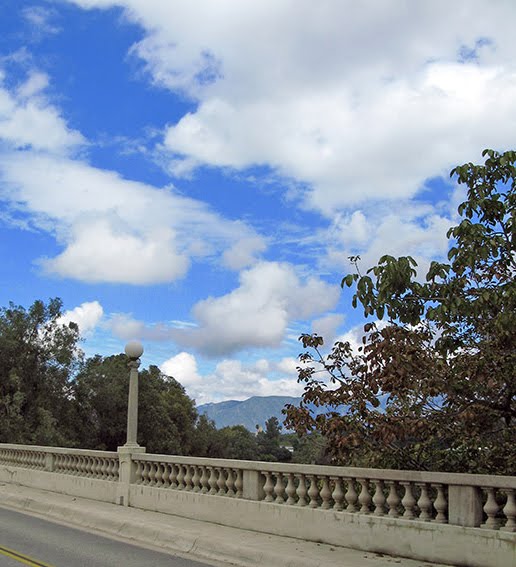
If you've never been on the San Rafael Bridge, it's the southernmost bridge over the Arroyo Seco in Pasadena. You can access it from South Arroyo Boulevard and from South San Rafael Avenue.

San Rafael Bridge is one of the contributing resources of the Arroyo Seco Parks and Recreation Historic District, which is on the National Register of Historic Places. Others among the 14 contributing resources include Brookside Golf Club, Rose Bowl Stadium, Brookside Park, Holly Street Bridge, Colorado Street Bridge, Mayberry/Parker Bridge, La Casita del Arroyo, Lower Arroyo Seco Park and the Bird Sanctuary.

Thursday, September 16, 2010

Mystery History -- Solved!


I liked the variety of guesses for this one, from "miners digging out the last of our coal and/or gold reserves" to "it has something to do with a dam being built at the bottom of Hahamongna."

Frank Girardot wins with his 3:56 p.m. Tuesday guess "building of the rose bowl in arroyo seco."

I tried to throw everybody off the scent by cropping in on this photo:


Architect Myron Hunt designed the Rose Bowl Stadium, which for several years was a horseshoe shape that was open on the south side. Here's Hunt, right, looking over an early model with builder William A. Taylor:


And here's an aerial shot of the nearly completed stadium:


But the project really began with laborers and mules. Imagine the back-breaking work of digging out all that dirt along with all those rocks and boulders.


In 1920, to fund the stadium's $272,000 construction, Myron Hunt, Tournament of Roses President William Leishman and several others devised a plan to sell subscription tickets for stadium events for the next 10 years at a cost of $10 per person per year -- $100 total -- all up front. It worked.

Construction took less than a year; the stadium was ready in time for the 1923 football game with USC vs. Penn State (USC won, 14 to 3).


And now the stadium is poised for a $171 million renovation and expansion. Design plans are going through the commission process and the financial plan will be coming to the Pasadena City Council soon.

It's a far cry from the $272,000 raised to build the stadium 90 years ago but it sure will be worth it!

I'll leave you with this aerial shot of the stadium during the BCS final game on Jan. 7 this year (Alabama 37, Texas 21):


Many thanks to the Pasadena Museum of History, Rose Bowl Stadium and Tournament of Roses Association.

Thursday, June 17, 2010

Mystery History -- Solved


Karin wins with her 10:33 a.m. Tuesday guess "The Mother Goose Pantry Restaurant on Colorado Blvd, built 1929. Nathaniel West used it as inspiration for the Cinderella Bar in Day of the Locust."

From the looks of the photo above, the proprietor had so many patrons she didn't know what to do! But I doubt she beat them all soundly and put them to bed.

Diners were seated on the ground floor and in a dining room upstairs.

The architectural style is known as roadside vernacular, which dotted the U.S. in the early to mid-20th century.

Sure enough, one of the settings in "The Day of the Locust" by Nathanael West is the Cinderella Bar, shaped like the iconic glass slipper but made of stucco, where female impersonators entertain the clientele. The novel, published in 1939, takes place in Hollywood during the Great Depression. There's also a film based on the novel, produced in 1975.

And now there's a (rather tacky) collectible version of the Mother Goose Pantry.


For some reason there's not much information to be found about Mother Goose Pantry. There is conflicting information on the Internet about what year the restaurant was constructed and what the address was, but there's definitely agreement that it was built sometime in the 1920s somewhere on Colorado Boulevard.


So I turned to Dan McLaughlin, one of our crackerjack researchers at Pasadena Central Library, who looked in old city directories. These wonderful books were published for many years and can serve as a pretty good snapshot into the history of specific addresses.

Mother Goose Pantry is listed in the 1927 city directory as being at 1955 E. Colorado Blvd. So I'm taking that address as gospel. It was on the north side of the street near Berkeley Avenue, about three blocks east of Allen Avenue.


Here's a vintage menu from the Mother Goose Pantry that I found on an auction website, but I'm afraid I lost track of which one (it wasn't eBay). I wish an image of the inside of the menu had been included.


Thinking of constructing a building in the roadside vernacular style? Make sure the property's zoned for that!


Many thanks to Pasadena Public Library.

Thursday, January 28, 2010

Mystery History -- Not Quite Solved


For the second time in Mystery History, um, history, I'm not prepared yet with the full scoop!

I had some newspaper articles that we were absolutely, positively sure were all about the background to the photos on the contact sheet above, but on closer inspection yesterday the articles are from 1926.

Trouble is, the photos above were clearly shot at Pasadena City Hall (the fountain and the urns are the dead giveaways). This building didn't open until the following year.

Give me a little more time to continue this wild goose chase -- with the help of Martha Camacho, one of our crackerjack researchers at Pasadena Public Library.

Stay tuned...

And remember -- Mayor Bill Bogaard's 2010 State of the City event is tonight! It's free and open to the public.

Thursday, December 31, 2009

Mystery History -- Solved


With apologies for the morbidity:

Mike Salazar wins with his Wednesday 6:30 p.m. guess "This is the collapsed bleachers at Rose Parade. Forget the year - 1926 or so."

In the photo above, City of Pasadena public safety personnel look over the rubble left behind after a grandstand collapsed during the Rose Parade on Jan. 1, 1926. Eight spectators died.

It was a terrible tragedy that, thanks to resulting regulations for careful construction and inspection of grandstands, has not happened again. It was also an early experience in hands-on disaster management for Pasadena public safety personnel.

Excerpt from an Associated Press report:

Pasadena, with its hundreds of thousands of guests for the thirty seventh annual Tournament of Roses pageant, was thrown from a scene of joyous enthusiasm into a turbulent tragedy when a grandstand seating 350 men, women and children collapsed as the floral parade was passing and 135 more women and children were injured and taken to hospitals while about 100 others were given first aid treatment.
An investigation determined that the collapse was caused by many structural flaws, including poor-grade lumber, poor workmanship and no cross bracing.

The contractor responsible for the grandstand was convicted of manslaughter but prosecutors dropped the charges when a new trial was ordered a year later.

Esotouric gives occasional scene-of-the-crime tours of Pasadena that include the very spot where the collapse happened. (They also include the bungalow where Robert F. Kennedy assassin Sirhan Sirhan lived and other locations with creepy histories.)

This seems like an odd transition but...

...on a happier note:

Fay Lanphier was the Rose Queen. She had been crowned Miss California in 1924 and Miss America in 1925.


Col. L.J. Mygatt was the grand marshal. He had commanded the U. S. Army Air Corps Balloon School in France during World War I and then the Balloon School at Ross Field in Arcadia.


Later that day, the first local radio broadcast of the Rose Bowl Game featured sportswriter and former Olympian Charlie Paddock doing the color commentary. Alabama beat Washington by just one point -- 20 to 19. Now that's a game!


Now it's one day shy of 84 years later. The 2010 New Year's Day events are tomorrow!

And as it was in 1926, crews from the Street Maintenance and Integrated Waste Management Division of the Public Works Department will remove tons of litter and other materials and leave the 11 miles (5.5 miles, up one side of the street and down the other) of the parade route squeaky clean. They do magnificent work that continues all through the night!

Thankfully they won't have to remove any collapsed grandstands.


Many thanks to Los Angeles Public Library, Tournament of Roses Association and eBay for use of the photos.

Thursday, December 3, 2009

Mystery History -- Solved


Elijah wins with his 7 a.m. Tuesday guess "Is Myron Hunt posing by the fountain in the Central Library courtyard at the library's dedication in 1927?"

In the photo above, architect Myron Hunt stands next to the courtyard fountain during dedication ceremonies for the new Pasadena Public Library on Feb. 12, 1927.

During the festivities Hunt gave the $586,000 building's keys to City Librarian Jeanette Drake (left in photo below) and received the Arthur Noble Civic Award from Franklin B. Cole, chairman of the Pasadena Board of City Directors (center).


Here's the award he received.


All of the Arthur Noble Civic Award recipients are listed on a wall plaque in the council chamber at Pasadena City Hall.


Learn more about the library's architecture here.

Myron Hunt designed many iconic buildings and other structures, including this little gem.

To answer Barbara Ellis's question, when the fountain was renovated in 2002, it was dedicated to long-time Pasadena Public Library Foundation volunteers Ann Jarvis Longyear and her husband Douglas McKay Longyear. The $15,000 cost of the renovation was donated by individuals specifically to honor the Longyears for their dedication. The renovation carefully preserved the flavor of the fountain, designed in 1927 to replicate one at the Alhambra in Granada, Spain.


Many thanks to Pasadena Public Library and Los Angeles Public Library.

Thursday, November 26, 2009

Mystery History -- Solved


Happy Thanksgiving!

JM comes closest with his/her guess "The field of the Rose Bowl or at Tournament House and this is part of the Rose Queen selection. Sorry, don't know the year." (JM, please email me at aerdman@cityofpasadena.net and I'll tell you about your fabulous prize.)

In the photo above, contestants for Rose Queen of 1930 pose in late 1929 inside a giant question mark.

The winner was Holly Halstead, below (and third from the bottom in the question mark).


She passed away in July 2004 at 95. From an article the following week:

When Holly Halstead Balthis reigned as the queen of the Tournament of Roses in 1930, the Rose Bowl was only 7 years old, and, as she once noted, Old Town Pasadena was new.

Mrs. Balthis, the oldest living Rose Queen, died at age 95 of natural causes Friday at her home in Laguna Beach, said her son and sole survivor, Frank Balthis Jr.

Mrs. Balthis never dreamed her stint as Rose Queen would mean much once it ended.

"I thought it was a short deal, New Year's Day, and that'd be it," she said in a 1986 interview. "But it's something that stays with you all your life."

Indeed, in recent decades Mrs. Balthis was considered "the grand dame" of the Tournament of Roses. She remained active in tournament functions up until her death and each year welcomed the new queen.

Mrs. Balthis was born in Pasadena in 1908 and graduated from Pasadena High School in 1925.

"At first I felt overwhelmed and honored, but I think I really did it because of my dad," she said. "He was so proud of the fact he had been an early comer to Pasadena."

Her escort was her future husband, Frank S. Balthis, a Harvard law student who would later become a Superior Court judge and an appellate court justice.
Halstead Street in Pasadena was named after her father, Richard Halstead, who was a prominent businessman.

The grand marshal of the 1930 Rose Parade was James "Sunny Jim" Rolph, mayor of San Francisco.


Every week my Mystery History posts have something to do with City of Pasadena operations. So how does this post apply?

The City of Pasadena and the Tournament of Roses Association have a long-term contract. As we get a little closer to the end of the year, I'll go into more detail about that.

Suffice it to say that we're going into high gear here at City Hall. Every year, as the T of R maneuvers the monumental task of planning the parade and the game, the City of Pasadena is behind the scenes inspecting grandstands, barricading streets, planning traffic control, managing public safety, cleaning streets afterwards, you name it.

The New Year's Day operations manuals for the Public Works Department, Police Department, etc., are voluminous.

And do you know the City of Pasadena owns the Wrigley Mansion (Tournament House)?


Here's 2010 Rose Queen Natalie Innocenzi at her coronation earlier this month.


Captain Chesley “Sully” Sullenberger will serve as grand marshal.


New Year's Day is just over a month away. We're off and running!


Many thanks to Pasadena Public Library, Los Angeles Public Library and Tournament of Roses Association.

Wednesday, October 21, 2009

Mystery History -- Solved

Mike Salazar wins with his Thursday 11:56 p.m. guess "They're building the new plunge at Brookside!"

In the photo above, ground is being excavated in 1923 for a new swimming pool -- called a "plunge" -- at Brookside Park to replace the original.

In 1912 the City of Pasadena purchased 30 acres of land known as Sheep Corral Springs for the development of a park in the Arroyo Seco. For many years sheep had grazed in that area.

  
While the park was being planned and constructed, it was known as Arroyo Springs Park. 

Then in 1914 Mrs. Everett Wellington Brooks, the wife of a local investment banker, donated $3,000 to build a municipal swimming pool on a portion of the land. The park was dedicated in her honor (hence "Brookside") and the plunge was added later that same year.

Here's a photo of the plunge, shot in 1917:


And this from 1938:


On Monday morning of this week, I was in the company of a few other local female bloggers*, all seated at the same table at the YWCA Women for Racial Justice breakfast.

As the keynote speaker, Dr. Joy DeGruy, explained, "Healing must occur on multiple levels because the injury occurred on multiple levels. We begin by simply telling the truth."

Many Pasadenans know the uncomfortable racial history of the Brookside plunge, but for those who don't I offer this brief description.

It was a different time in Pasadena and throughout the nation, and segregation was common.

Soon after the plunge was completed, city officials announced that it would be "set aside Wednesday afternoons and evenings for the use of the Negro population of Pasadena."

By 1930 use of the pool by people of color -- by now including residents of Hispanic and Asian descent -- was limited to one weekday from 2 to 5 p.m. The weekly event was dubbed "International Day." No white people were permitted to swim on that day. The pool was drained and cleaned at the end of each International Day and by the following morning there was fresh water in it.

From the book "Memoirs of Toshi Ito":

My homeroom class decided to have a graduation swim party and picnic at Brookside Park in Pasadena. Parents of our classmates and our homeroom teacher, Mrs. Hanna Yoeman, drove us to Brookside Park. We had a wonderful picnic lunch and played some games to pass the time because it was not good for you to go in the water right after eating a meal. We all lined up to pay the plunge fee and rent a towel. When Motomu Nagasako, a Japanese American, got up to the window to pay he was told Orientals were not allowed to use the plunge. There were five Japanese Americans in my homeroom class. He had the embarrassing task to tell us we were excluded. We all glumly sat on the lawn watching the others frolicking in the swimming poool and wishing the afternoon would end and we could all go home. It was my first encounter with being excluded.
On June 17, 1939, with the support of the Los Angeles branch of the NAACP, six African American men, who continually had no right to use the plunge except for the weekly International Day, filed a lawsuit against the Pasadena Board of City Directors, the city manager and the superientendent of Pasadena parks.

Part of their legal argument was that they were tax-paying Pasadena property owners who therefore had helped fund the construction and maintenance of the plunge and should have had the right to use it on the same days as white residents.

On Jan. 3, 1940, the court ruled in favor of the City of Pasadena. The NAACP immediately appealed and won the case, after which the city petitioned the California Supreme Court. The court denied the petition.

This was great news for people of color in Pasadena, but the timing was poor. World War II was in full swing, and emergency housing for soldiers returning from European battlefields was constructed at Brookside Park. The pool was closed and exclusive use of the showers and restrooms was given to the veterans.

In February 1947, after the war was over and the housing shortage had ended, the Board of Pasadena City Directors authorized $10,000 for rehabilitation of the plunge.

The pool reopened to the public on June 7, 1947 and -- 33 years after the original plunge opened -- was finally accessible to all swimmers in Pasadena, regardless of their race.

In 1989 the Rose Bowl Aquatics Center opened on the site, funded with $4.5 million from the City of Pasadena and $2 million in private donations.


From water aerobics and recreational swimming to water polo and diving teams, the RBAC is open to all and is a very popular with swimmers of all ages. If you're interested in swimming, diving, water polo, water aerobics, warm-pool therapy, swimming lessons, competition and more, check out the RBAC next time you're in the neighborhood. It's at the far southwest end of Brookside Park at 360 N. Arroyo Blvd.

* Petrea Burchard, Colleen Bates, Karin Bugge, Susan Carrier, Dianne Patrizzi, Kelly Russell and Susan Russell.

Thursday, July 23, 2009

Mystery History -- Solved


Jonathon wins with his guess "It's the Pasadena Motorcycle Club, founded in 1907."

In the photo above, members of the Pasadena Motorcycle Club pose for posterity before heading out for a 163-mile round-trip rally to Ventura on April 28, 1911.

They're in front of the Victor Marsh Building at the northeast corner of Raymond Avenue and Green Street. The building still stands today, although it has been significantly altered. The first floor at that corner is now occupied by redwhite+bluezz.

Here's a photo of Carl Marsh on the way to Pasadena for the rally, stopping to rest with his Indian among the orange groves.


Founded in 1907 as a sporting club that held Hare and Hound races in the local orange groves, the Pasadena Motorcycle Club celebrated its 100th anniversary in 2007.

Here are club members in 1925:


They even have a Facebook page!