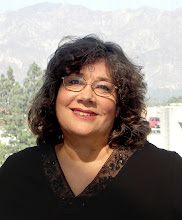
I stumped everybody again! I love this image so much that I assumed it must be iconic.
In the photo above, Jeanne Carr is standing on a balcony at her 22-room home "Carmelita" at 470 Kensington in 1892, the last year she would live there.
Here's a portion of the home from a different angle:

The 42-acre property was bordered by Colorado Street to the south, Orange Grove Boulevard to the west and Fair Oaks Avenue to the east.
And here's another side of the home, this one covered in wisteria:

Mrs. Carr was quite an accomplished woman in her day. She was an expert horticulturist who planned and planted what would become known as Carmelita Gardens and, years later, Carmelita Park.
Her husband, Dr. Ezra S. Carr, was a medical doctor and career educator who had been a professor of chemistry, agriculture and natural history at the University of Wisconsin before moving on to UC Berkeley and then spending the twilight of his career as the superintendent of public instruction for the State of California from 1875 to 1880.
Here's Dr. Carr relaxing in the shade of the wisteria:

While living in the Bay Area, the Carrs traveled many times to Pasadena. During one such trip they purchased the 42-acre property and planted orange groves that were a highly successful venture for them as they planned and saved for eventual retirement to the area.
Once they moved permanently to Pasadena in 1880, they opted out of the citrus business and built a boarding house of sorts on the property.

It was actually an early cultural center where many famous people came to stay for extended periods of time, including
John Muir,
Ralph Waldo Emerson,
Helen Hunt Jackson,
Theodore Lukens,
William Keith and
Helena Modjeska.
Mrs. Carr also established a successful horticulture school for women on the property.
Here are the Carrs at a rustic cabin that was on the property when they purchased it. They loved it so much they could never bring themselves to demolish it.

Helen Hunt Jackson wrote part of her novel
“Ramona” in this little cabin.
Mrs. Carr set the standard for refined Pasadena landscaping in that era, such as using hedges instead of fences, planting flowering shrubs and trees, etc.
Carmelita had the most extensive garden in Pasadena, filled with plants from all over the world.
Some were planted by John Muir himself. He had been a student of Dr. Carr's at the University of Wisconsin; Mrs. Carr was a mentor to Muir and encouraged him to get his papers published.

Here's a letter from John Muir to Jeanne Carr written on Aug. 12, 1877:
Dear Mrs. Carr:
I've seen your sunny Pasadena and the patch called yours.
Everything about here pleases me and I felt sorely tempted to take Dr. Congar's advice and invest in an orange patch myself. I feel sure you will be happy here with the Doctor and Allie among so rich a luxuriance of sunny vegetation, How you will dig and dibble in that mellow loam! I cannot think of you standing erect for a single moment, unless it be in looking away out into the dreamy West.
I made a fine shaggy little five days' excursion back in the heart of the San Gabriel Mountains, and then a week of real pleasure with Congar resurrecting the past about Madison. He has a fine little farm, fine little family, and fine cozy home. I felt at home with Congar and at once took possession of his premises and all that in them is. We drove down through the settlements eastward and saw the best orange groves and vineyards, but the mountains I, as usual, met alone. Although so gray and silent and unpromising they are full of wild gardens and ferneries. Lilyries!--some specimens ten feet high with twenty lilies, big enough for bonnets! The main results I will tell you some other time, should you ever have an hour's leisure.
I go North to-day, by rail to Newhall, thence by stage to Soledad and on to Monterey, where I will take to the woods and feel my way in free study to San Francisco. May reach the City about, the middle of next month. . . .
Ever cordially
J. M.
In 1892 the Carrs sold the property to Simeon Reed, founder of
Reed College in Oregon. He and his wife Amanda had great plans for building a new home for themselves at Carmelita, but Simeon Reed died of a stroke in 1895. Mrs. Reed continued to live in Pasadena until her death in 1905.
OK, so fast forward to 1941.
The property was gifted to the City of Pasadena on the condition that the Pasadena Art Institute could be located there. The institute leased the property for 20 years on the condition that a permanent museum be constructed on the site.
Since 1975 the
Norton Simon Museum has occupied about seven acres that are still owned by the City of Pasadena.
Some of the trees and shrubs in the Norton Simon Museum gardens are more than a century old and planted by Jeanne Carr and others, but most of the gardens are more recent.

Many thanks to Pasadena Public Library, Pasadena Museum of History, University of Southern California and Norton Simon Museum.